


POS System for Pharmacies in Kenya: The Complete 2026 Buyer’s Guide

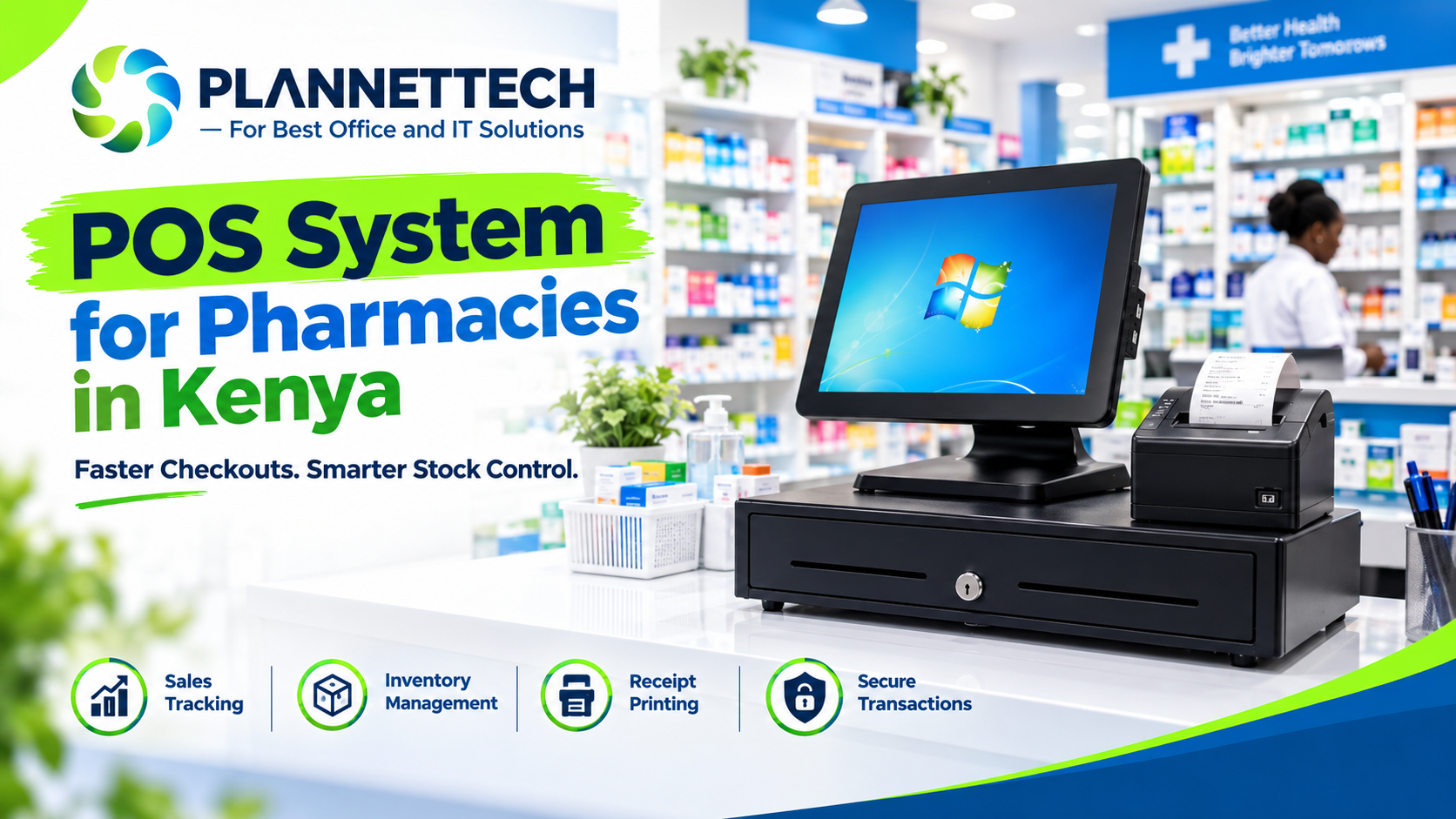
A reliable POS system for pharmacies in Kenya is no longer a luxury reserved for large chains. It is the tool that decides whether your shelves stay stocked, your expiry dates stay under control, and your tax records match what the Kenya Revenue Authority expects. If you still record sales in a notebook or on a basic till, this guide explains what a POS system for pharmacies in Kenya should do, what to look for, and how to choose one that fits your outlet.
The pharmacy sector is growing quickly, which means more competition for every customer. The Pharmacy and Poisons Board reports that registered pharmaceutical premises rose from 6,852 in 2018 to 10,497 by June 2026. In a market this crowded, a POS system for pharmacies in Kenya helps you serve customers faster, price correctly, and stop losing money to expired stock, pilferage, and manual errors.
Plannettech supplies POS systems and eTIMS devices to Kenyan businesses, and this guide is written to answer the practical questions pharmacy owners face when comparing options. It covers regulation, tax, features, hardware, costs, implementation, and common mistakes, so that you can choose a POS system for pharmacies in Kenya with confidence before you spend a single shilling.
What Is a POS system for pharmacies in Kenya?
A POS system for pharmacies in Kenya is a combination of software and hardware that records every sale, tracks every item in stock, accepts payments, and prints receipts. The software runs on a computer, tablet, or touchscreen terminal. The hardware usually includes a barcode scanner, a receipt printer, and a cash drawer. Together, they replace handwritten sales books and scattered spreadsheets with one accurate record of your business.
A pharmacy has needs that a general shop does not. A generic retail till treats a box of antibiotics like a bar of soap, but a POS system for pharmacies in Kenya must track batch numbers and expiry dates, record who dispensed what, and separate prescription-only medicines from over-the-counter products. Those pharmacy-specific functions are what make the software worth paying for.
Why Pharmacies Need a POS system for pharmacies in Kenya Now
Regulation Is Getting Tighter
Oversight of the sector is increasing. The Pharmacy and Poisons Board announced a nationwide crackdown in which unlicensed outlets, licence renting and the sale of medicines in supermarkets and cosmetic shops face prosecution from January 2026. A POS system for pharmacies in Kenya does not replace your licence or your pharmacist, but it gives you clean, time-stamped records that show you run a legitimate and well-managed business.
The Board has also introduced Good Pharmacy Practice Standards that define the level of care expected in every licensed pharmacy, alongside stronger inspections, recalls and safety alerts. Accurate stock, supplier and dispensing records are much easier to keep with a POS system for pharmacies in Kenya than with paper books, especially when you must trace a particular batch. Check current requirements on the Pharmacy and Poisons Board website.
KRA eTIMS and Income Tax Validation
On tax, KRA has confirmed that all persons carrying on business must generate and transmit invoices through eTIMS, unless they are exempted, and that includes businesses that are not VAT-registered. A POS system for pharmacies in Kenya that connects to eTIMS sends each sale to KRA automatically, so your cashier does not have to key invoices into a separate portal.
There is a second reason to take eTIMS seriously. KRA announced that from 1 January 2026 it would validate the income and expenses declared in tax returns against eTIMS invoices and other data sources. For a pharmacy, that means supplier purchases and daily sales should both be properly documented. A POS system for pharmacies in Kenya that records supplier invoices and sales together makes that reconciliation far simpler at filing time.
Pharmacies also face a tax classification question. Some products are VAT-exempt, some are zero-rated, and others attract standard VAT, and eTIMS applies to both taxable and exempt supplies. A good POS system for pharmacies in Kenya lets you set the tax class for each product once and applies it automatically on every sale. Confirm the correct classification with KRA or your tax adviser, and read our guide on eTIMS for non-VAT registered businesses if you are below the VAT threshold.
SHA Requirements and Patient Data
Health financing is changing as well. The Social Health Authority has notified providers that an accredited Health Management Information System will be a strict requirement in the FY 2026/28 contracting cycle for facilities that want to join SHA-funded schemes. Requirements differ by provider type, so confirm with SHA how they apply to your outlet, and choose a POS system for pharmacies in Kenya whose vendor can adapt as digital health rules evolve.
Customer information also carries legal duties. Health information counts as sensitive personal data under Kenya’s Data Protection Act, 2019, so prescription and patient details must be handled carefully. Guidance is available from the Office of the Data Protection Commissioner. A POS system for pharmacies in Kenya should therefore offer individual logins, role-based permissions, and an audit trail that shows who viewed or changed a record.
Key Features of a POS system for pharmacies in Kenya
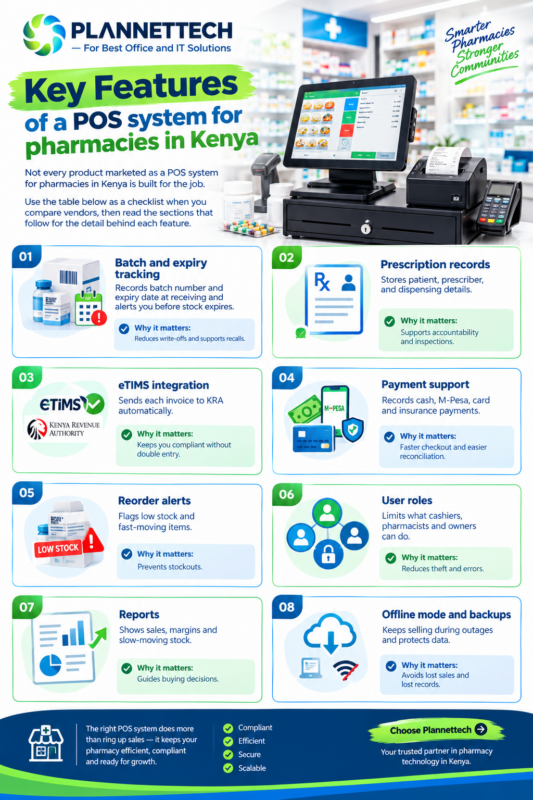
Not every product marketed as a POS system for pharmacies in Kenya is built for the job. Use the table below as a checklist when you compare vendors, then read the sections that follow for the detail behind each feature.
| Feature | What it does | Why it matters |
| Batch and expiry tracking | Records batch number and expiry date at receiving and alerts you before stock expires | Reduces write-offs and supports recalls |
| Prescription records | Stores patient, prescriber, and dispensing details | Supports accountability and inspections |
| eTIMS integration | Sends each invoice to KRA automatically | Keeps you compliant without double entry |
| Payment support | Records cash, M-Pesa, card and insurance payments | Faster checkout and easier reconciliation |
| Reorder alerts | Flags low stock and fast-moving items | Prevents stockouts |
| User roles | Limits what cashiers, pharmacists and owners can do | Reduces theft and errors |
| Reports | Shows sales, margins and slow-moving stock | Guides buying decisions |
| Offline mode and backups | Keeps selling during outages and protects data | Avoids lost sales and lost records |
Batch and Expiry Tracking
Expiry management is the single most valuable function of a POS system for pharmacies in Kenya. The system should capture the batch number and expiry date when stock arrives, then sell the earliest-expiring batch first. It should also warn you well in advance, for example at 90, 60, and 30 days, so that you can discount, return or rotate stock before it becomes a loss. Batch records also help you act quickly when a recall or safety alert is issued.
Prescription and Controlled-Medicine Records
Dispensing records are the next priority. A POS system for pharmacies in Kenya should let your pharmacist record the patient, the prescriber, the quantity, and the date for medicines that need a prescription. These entries are searchable in seconds, which is far better than flipping through registers. Always confirm the exact record-keeping rules for your premises with the Pharmacy and Poisons Board, because the system should support those rules rather than replace them.
Inventory, Reorder and Supplier Management
Stock control is where money is won or lost. A POS system for pharmacies in Kenya should show current stock for every product, suggest what to reorder using minimum levels you set, and produce purchase orders for your suppliers. When goods arrive, you receive them against the order, capture the supplier invoice, and update your cost prices automatically. That discipline prevents stockouts of fast-moving items and stops cash being tied up in slow ones.
Payments, Insurance and Credit
Customers pay in many ways, and your system must keep up. A POS system for pharmacies in Kenya should record cash, M-Pesa, card payments, and split payments in a single sale. It should also handle insured customers by capturing member details and co-payments, and manage credit accounts for regular clients such as clinics or institutions. End-of-day reports then show exactly what you should have in the till, in M-Pesa, and on account.
Reports and Multi-Branch Control
Good reporting turns raw data into decisions. With a POS system for pharmacies in Kenya, you can see profit by product and category, your fastest and slowest movers, daily cashier totals, and the value of stock on hand. If you own several outlets, a central dashboard lets you compare branches, move stock between them and spot problems early, without waiting for monthly paper summaries from each location.
User Roles and Audit Trails
Security protects your margins. A POS system for pharmacies in Kenya should give cashiers, pharmacists and owners different permissions, so that only authorised people can change prices, apply discounts, void sales or adjust stock. Every action is logged against a user and a time. That audit trail discourages theft, makes mistakes easy to trace and builds trust between owners and staff.
Offline Mode and Backups
Power cuts and weak internet are a daily reality in many areas. A dependable POS system for pharmacies in Kenya continues to record sales when the connection drops and syncs automatically when it returns. It should also back up your data to a secure location every day, so that a stolen computer or a failed disk does not wipe out your stock history. Ask each vendor to explain exactly how this works.
Hardware for a Pharmacy POS Setup
Software is only half of the investment. A complete POS system for pharmacies in Kenya normally needs a computer or touchscreen terminal, a barcode scanner, a thermal receipt printer, a cash drawer, and, where relevant, a label printer for dispensing labels. A UPS or other power backup is also wise. Buying matched, tested equipment from a single supplier avoids compatibility headaches later.
Receipt printing deserves attention because customers expect a proper receipt, and eTIMS invoices carry a QR code that lets them verify the invoice with KRA. A fast thermal printer also keeps queues moving at the counter. Plannettech offers a range of printers, so ask which model pairs well with your POS system for pharmacies in Kenya.
You also need to decide how your system connects to KRA. Some businesses use a dedicated eTIMS device, while others use software that integrates directly with eTIMS. KRA provides a list of approved integrators, so confirm that any vendor offering a POS system for pharmacies in Kenya is on it. Our comparison of ETR machines and eTIMS in Kenya explains the differences, and you can browse our eTIMS devices if you prefer a device-based route.
Finally, think about physical security. A strong POS system for pharmacies in Kenya protects your data, but cash and stock also need protection. Place the terminal where staff and cameras can see it, bank cash regularly, and use tamper-evident security seals on cash bags and delivery cartons so that any interference is obvious. Plannettech supplies security seals for this purpose.
How to Choose the Best POS system for pharmacies in Kenya
Start by defining your needs. Count your outlets, cashiers, and products, and note whether you sell retail only or wholesale as well. A single-counter chemist and a five-branch group need different things from a POS system for pharmacies in Kenya. Our guide to a POS system for supermarket in Kenya shows how larger retail setups differ. Writing down your must-have features before you speak to vendors prevents you from paying for extras.
Next, test compliance. Ask every vendor to demonstrate eTIMS invoicing live, not in a brochure. Watch a sale go through, see the invoice reach KRA, and check how credit notes and returns are handled. A POS system for pharmacies in Kenya that cannot show this clearly is a risk to your business, because invoicing errors can lead to penalties and difficult conversations with the tax authority.
Then test the pharmacy-specific features. Ask the vendor to receive a delivery with batch and expiry details, sell an item, trigger an expiry alert, and process a return of expired stock. A POS system for pharmacies in Kenya should handle all of these without workarounds. If the salesperson says a feature is planned for a future update, treat it as missing today.
Ease of use and local support matter just as much as features. Staff turnover is common, so the screens should be simple enough for a new cashier to learn quickly. Ask where support is based, how fast the vendor responds, and whether training is included. A POS system for pharmacies in Kenya that is supported by a local team can be fixed in hours rather than days when something goes wrong.
How Much Does a POS system for pharmacies in Kenya Cost?
Prices vary widely, so no honest article can quote a single figure. The cost of a POS system for pharmacies in Kenya depends on the number of terminals, the number of branches, the hardware you choose, and the support you need. The table below lists the main cost factors and the question to ask about each, so that you can compare quotations on the same basis.
| Cost factor | What to ask |
| Software licence or subscription | Is it a one-off licence or a monthly or annual fee, and what does it include? |
| Hardware | Which scanner, printer, cash drawer and terminal are in the quote, and what is the warranty? |
| eTIMS integration | Is the KRA connection included or charged separately? |
| Installation and training | Is on-site setup and staff training included? |
| Support and updates | What are the response times, and are updates free? |
| Extra branches or users | What does each additional terminal or outlet cost? |
You will usually choose between a one-off licence and a subscription. A one-off licence may look cheaper at first but often carries annual support and update fees. A subscription spreads the cost and normally includes updates and cloud backup. Compare the total cost over three years for each option, because that gives a fairer picture of what a POS system for pharmacies in Kenya really costs your business.
Think about return as well as cost. A POS system for pharmacies in Kenya can cut losses from expired stock, reduce pricing and arithmetic mistakes, prevent stockouts, and shorten queues. Measure your expiry write-offs, stock differences, and daily sales for a month before installation, then compare the same figures after three months. That comparison shows the real payback and helps you decide whether to add terminals or branches.
Implementing Your POS system for pharmacies in Kenya Step by Step
Step one is data preparation. Clean up your product list so that each item has a clear name, unit of measure, barcode, tax class, cost price, selling price, and reorder level. Duplicated or badly named items confuse for years. Spending a few days on this before launch makes your POS system for pharmacies in Kenya far more accurate from the first sale.
Step two is the opening stock count. Count every product and record its batch number and expiry date, ideally after closing hours so that sales do not disturb the figures. Enter these as opening balances. A POS system for pharmacies in Kenya is only as accurate as the stock it starts with, and a careful count at this stage saves many corrections later.
Step three is training and a pilot. Set up user accounts and permissions, train every cashier and pharmacist, and run the new system alongside your old method for about a week. Compare the totals each day. This parallel run builds confidence and exposes problems while the risk is low, so your POS system for pharmacies in Kenya is stable by the time you rely on it fully.
Step four is going live and reviewing. Reconcile cash, M-Pesa and eTIMS invoices every evening, review expiry reports weekly and check margins monthly. Use the figures when you place supplier orders and when you prepare your tax filings. A POS system for pharmacies in Kenya delivers value only when the owner actually reads the reports, so build a regular review into your routine.
Common Mistakes When Buying a POS system for pharmacies in Kenya
The first mistake is buying a generic retail till. It may look cheaper, but without batch and expiry control, it cannot do the main job of a POS system for pharmacies in Kenya. You will end up paying twice, once for the wrong system and again for the replacement.
The second mistake is leaving eTIMS until later. KRA already uses eTIMS data to check returns, so late integration can create gaps in your records. Choose a POS system for pharmacies in Kenya that handles eTIMS from the first day, and do not rely on manual workarounds that staff will eventually skip.
The third mistake is skipping training and permissions. Giving every employee full access invites errors and theft. Define roles, train people properly, and review the audit log regularly. A POS system for pharmacies in Kenya protects you only when its security settings are actually used.
The fourth mistake is having no backup or power plan. A computer failure on a busy Saturday can stop sales and destroy records. Use a UPS, schedule daily backups, and keep a simple written procedure for outages. Ask your vendor how the POS system for pharmacies in Kenya recovers after a crash, and test the answer.
The fifth mistake is choosing purely on price. The lowest quotation often leaves out hardware, eTIMS integration, training, or support. Compare complete quotations line by line, and judge a POS system for pharmacies in Kenya on its total cost, its features and the quality of the support behind it, not on the headline figure alone.
How Plannettech Can Help
Plannettech Investors Limited is a Kenyan supplier of technology and office equipment, including POS systems, eTIMS devices and printers. If you are comparing options for a POS system for pharmacies in Kenya, our team can explain what hardware you need, how eTIMS connects to your till, and what a sensible setup looks like for your size of outlet.
To get started, list your outlets, cashiers, and must-have features, then contact Plannettech for a demonstration and a written quotation. Confirm which software and hardware options are currently available for pharmacies, so that your POS system for pharmacies in Kenya is chosen on facts, with clear costs and support terms agreed before you buy.
Frequently Asked Questions
What is the best POS system for pharmacies in Kenya?
There is no single best option for every chemist. The best POS system for pharmacies in Kenya is the one that handles batch and expiry tracking, eTIMS invoicing, M-Pesa payments, and clear reports, and that comes with reliable local support. Compare vendors on those points using a live demonstration.
Must a POS system for pharmacies in Kenya be eTIMS compliant?
KRA requires all businesses to issue invoices through eTIMS unless they are exempt. A POS system for pharmacies in Kenya that integrates with eTIMS makes this automatic. Confirm your own position with KRA or a tax adviser, especially for exempt products.
How much does a POS system for pharmacies in Kenya cost?
The cost depends on the number of terminals, branches, hardware, eTIMS integration, and support. A POS system for pharmacies in Kenya may be sold as a one-off licence or a subscription, so compare the three-year total. Request a written quotation from Plannettech to see the exact figures for your outlet.
Can a POS system for pharmacies in Kenya work without internet?
Many systems record sales offline and sync later, but sending invoices to KRA needs a connection. Ask how your POS system for pharmacies in Kenya handles downtime, and make sure you have a documented procedure for outages.
Is a POS system for pharmacies in Kenya worth it for a small chemist?
Yes. Even a single-counter chemist loses money to expired stock, pricing errors, and untracked sales. A POS system for pharmacies in Kenya gives a small outlet the same control and tax compliance as a larger one, and an entry-level setup needs only a terminal, scanner, and printer.
Final Thoughts
Choosing a POS system for pharmacies in Kenya is a business decision, not just a technology purchase. The right system keeps your stock fresh, your sales accurate, and your tax records ready for KRA, while the wrong one adds cost and stress. Focus on batch and expiry control, eTIMS integration, local support, and a clear total cost.
If you are ready to move from notebooks to a modern POS system for pharmacies in Kenya, Plannettech can help you compare options and set up the hardware. Visit plannettech.co.ke or contact our team today to request a demonstration and quotation.