


ETR Machine vs eTIMS in Kenya: Which Does Your Business Need in 2026?

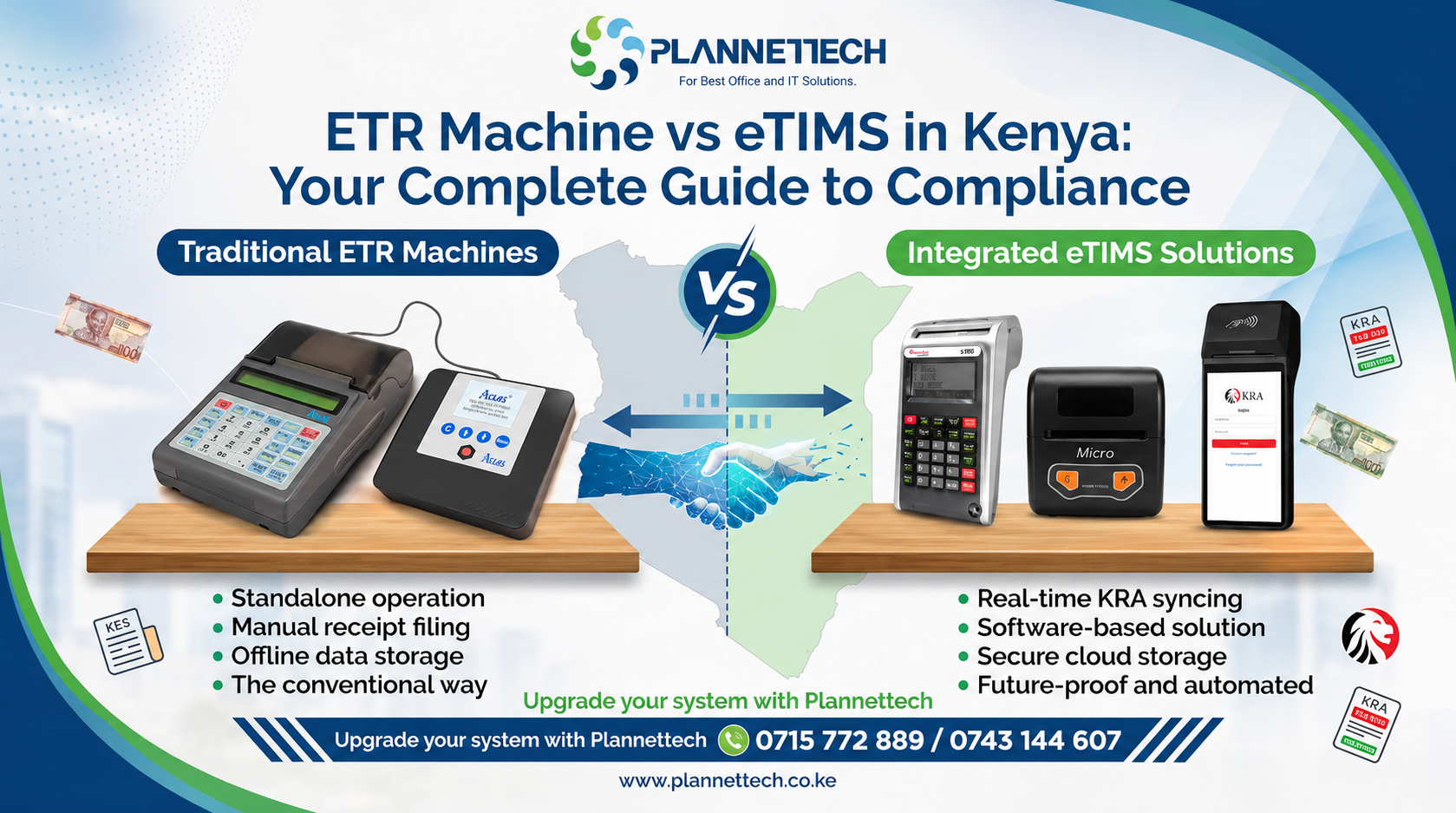
If you run a shop, a restaurant, a pharmacy, or any other business in Kenya, you have probably asked the same question many other traders are asking about ETR machine vs eTIMS in Kenya: should I buy an ETR machine, or should I move to eTIMS? The answer matters more in 2026 than it did a few years ago, because the Kenya Revenue Authority (KRA) now uses eTIMS data to check the income and expenses you declare in your tax return.
The short version is this. For most small and growing businesses in Kenya, eTIMS is the better choice because KRA now builds its compliance checks around it, and it provides basic versions at no cost. An ETR machine is not automatically wrong, and a TIMS-compliant device still has a place in some businesses. But buying a standalone ETR machine just to comply, without thinking about eTIMS, is usually the more expensive and less flexible route.
In this guide to ETR machine vs eTIMS in Kenya, we explain how the two compare, what the rules say, which option suits micro and small enterprises (MSEs) and small and medium enterprises (SMEs), and how to switch without disrupting your sales. We have also added a detailed FAQ section at the end, so you can jump straight to the question that worries you most.
Note: tax rules change, so always confirm your own situation with KRA or a qualified tax adviser before you buy equipment or change systems.
Quick Answer: ETR Machine vs eTIMS in Kenya
- eTIMS is KRA’s electronic tax invoicing system. You issue tax invoices through software (a phone app, USSD, a web portal, a desktop client, or your own billing system), and each invoice is sent to KRA electronically.
- An ETR machine is a physical device that records sales and prints receipts. Older ETRs only stored data in the machine. Newer TIMS-compliant versions transmit data to KRA.
- Better for most SMEs and MSEs: eTIMS, often combined with a POS system that submits invoices automatically.
- Still relevant: a TIMS-compliant device already installed and working in your business, which you should check against KRA’s requirements before replacing.
What Is an ETR Machine?
An Electronic Tax Register (ETR) is a hardware device that records each sale, calculates VAT, and prints a fiscal receipt. KRA introduced ETRs many years ago to curb under-declaration of sales, and from 2005 many VAT-registered traders were required to use them.
The problem with the original ETR design was that the data stayed inside the machine. As Deloitte noted in a 2019 advisory reported by The Standard, the older ETR did not send data to iTax, and tampering and misdeclaration of sales weakened its effect.
That led to the Tax Invoice Management System (TIMS), which began its rollout in August 2021. TIMS-compliant ETRs are connected to KRA’s systems so that invoice data reaches the taxman in real time. Business Daily reported in 2022 that these devices retailed at roughly Sh45,000 to Sh120,000, with billing software costing extra, and that KRA had only authorised a limited number of suppliers. Those prices are from 2022, so treat them as a guide to the cost range, not as today’s quotes.
So when people say “ETR machine” today, they can mean two different things:
- An old, non-transmitting ETR that only stores data locally. This type does not meet the current requirement to transmit invoices electronically.
- A TIMS-compliant ETR or control unit that connects to KRA and sends invoice data.
Knowing which one you own, or are being offered, is the first step in any ETR machine vs eTIMS in Kenya decision.
What Is eTIMS?
eTIMS stands for Electronic Tax Invoice Management System. It is KRA’s current digital invoicing framework and the successor to the hardware-first approach. Instead of requiring everyone to buy a dedicated machine, eTIMS lets businesses issue tax invoices through several channels, all of which send invoice data to KRA.
According to HapaKenya’s guide to eTIMS, KRA provides several versions of the system:
- eTIMS Lite (USSD): accessed by dialling *222#, designed for very small traders.
- eTIMS Lite (mobile app): available on Google Play and the Apple App Store.
- eTIMS Client: a desktop application that supports preparing invoices offline and syncing with KRA later.
- eTIMS online portal: accessed through the official site at etims.kra.go.ke, using your KRA PIN.
- System-to-system integration: for businesses with an existing POS or accounting system that connects directly to KRA. KRA publishes integration guides on its eTIMS system-to-system integration page.
The same HapaKenya guide notes that KRA provides the eTIMS software at no cost, which can reduce the need to buy specialised hardware. Be careful, though: the software may be free, but a business that sells many items a day will still need a printer, a computer or tablet, and often a POS system to work efficiently.
When Did eTIMS Become Compulsory?
The rules have tightened in stages:
- 1 September 2023: all persons carrying on business in Kenya were required to generate and transmit invoices electronically through eTIMS, unless exempted, as explained in PKF East Africa’s tax alert.
- 1 January 2026: KRA began validating declared income and expenses in tax returns against eTIMS and TIMS data, withholding tax records, and customs data, according to KPMG Kenya’s briefing on eTIMS.
In practice, this means the ETR machine vs eTIMS in Kenya decision is no longer only about VAT. It affects how your annual return is checked, and it affects your customers too, because a business that buys from you needs a valid eTIMS invoice to support its own expense claims.
ETR Machine vs eTIMS in Kenya: Key Differences
| Factor | ETR machine (TIMS-compliant) | eTIMS |
|---|---|---|
| What it is | Physical device with a control unit | Software system with several access channels |
| Upfront cost | High, plus supplier and servicing costs | Basic versions provided by KRA at no cost |
| Setup | Supplier installation and activation | Online onboarding using your KRA PIN |
| Flexibility | Tied to the device | Works on phone, computer, web or integrated POS |
| Multiple branches | Needs devices or units per location | Client and integration options support multiple branches |
| Scalability | Limited by hardware | Can grow into a full POS or ERP integration |
| Stock records | Limited on older models | Stock management forms part of the compliance picture |
| Best for | Businesses that already own a working compliant device | Most new and growing SMEs and MSEs |
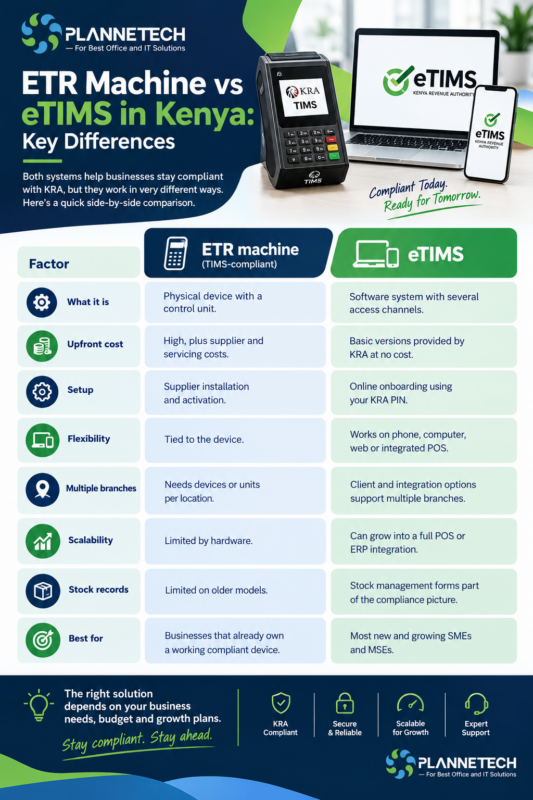
This ETR machine vs eTIMS in Kenya table is a general comparison. Your exact costs and suitability depend on your business size, your sales volume, and the systems you already use.
Do I Still Need an ETR Machine in Kenya?
This is one of the most common ETR machine vs eTIMS in Kenya questions, and the honest answer is: not necessarily.
The legal requirement is to issue electronic tax invoices and transmit them to KRA. It is not a requirement to own a specific brand of hardware. If you meet that requirement through eTIMS Lite, the eTIMS portal, the eTIMS Client, or an integrated POS, you are generally not obliged to buy a separate ETR machine just to comply.
That said, there are situations where keeping or using a TIMS-compliant device makes sense:
- You already own a TIMS-compliant device that is activated, working, and supported by your supplier.
- Your sector or contract has specific requirements that name particular equipment.
- You process a very high volume of transactions, and your current setup handles it reliably.
And there are situations where you should not rely on an old device:
- Your machine is an older ETR that only stores data and cannot transmit to KRA.
- Your supplier no longer supports it, or repairs have become frequent.
- You are opening additional branches and would need more hardware.
Because KRA’s requirements and notices can change, check with KRA directly or with your supplier before you decide to retire a device. Also remember that records from previously used ETRs must be kept. KRA has said traders must keep the data from earlier registers, as the law requires records to be kept for five years, so do not discard the data when you switch.
Which Is Better for SMEs and MSEs: ETR Machine vs eTIMS in Kenya?
When comparing ETR machine vs eTIMS in Kenya, remember that businesses are often grouped as micro, small, and medium enterprises. Under the Micro and Small Enterprises Act, micro enterprises are generally those with fewer than 10 employees, and small enterprises those with 10 to 49 employees. Medium enterprises are larger still. The right choice depends less on the label and more on how many sales you record each day, how many branches you run, and how comfortable your team is with technology.
eTIMS for Micro Enterprises (MSEs)
If you run a kiosk, a small salon, a mama mboga stall, a mitumba stand, or a one-person service business, eTIMS Lite is built for you, and it usually wins the ETR machine vs eTIMS in Kenya comparison for micro businesses. You can issue invoices from your phone through USSD or the app, with no hardware purchase. For a business with thin margins, avoiding a large upfront payment is a real advantage.
The trade-off is speed and record-keeping. Typing each invoice by hand on a phone is fine at 10 sales a day, but it becomes slow at 100. When that happens, it is time to move to a POS.
eTIMS for Small Enterprises
A small shop, restaurant, pharmacy or hardware store usually has a steady flow of customers, several products and staff who share the till. For these businesses, the most practical setup is eTIMS through an integrated POS system. The POS records the sale, prints the receipt, tracks stock, and submits the invoice to KRA in the background, so the cashier does not need to do a separate step.
A DEV Community guide to eTIMS for shops and restaurants describes the same idea: when a cashier closes a transaction, the POS submits the data to eTIMS automatically. That is far less error-prone than keying invoices into a separate tool at the end of the day.
eTIMS for Medium Enterprises and Multi-Branch Businesses
If you run several branches, a supermarket, a distribution company, or a wholesale operation, you need central control. The eTIMS Client and system-to-system integration are better matches, because they support multiple branches and connect with your existing billing or ERP system. At this scale, the question is rarely “ETR or eTIMS”. It is “which integrated POS or ERP is certified and reliable enough to handle our volume”.
A Simple ETR Machine vs eTIMS in Kenya Decision Guide
- Fewer than 20 sales a day, one person, tight budget: start with eTIMS Lite on your phone.
- Daily sales of 20 or more, stock to manage, more than one cashier: choose an eTIMS-integrated POS.
- Multiple branches or a large catalogue: choose an integrated POS or ERP, ideally with central reporting.
- You already own a working TIMS-compliant device: keep using it while you plan the move to a more flexible system.
ETR Machine vs eTIMS in Kenya: Cost Comparison
Cost is where many small businesses make the wrong decision, so it is worth separating the one-off costs from the running costs.
ETR machine costs usually include:
- The device itself, which was priced between roughly Sh45,000 and Sh120,000 in 2022, according to Business Daily
- Billing or integration software, if needed
- Installation and activation by an approved supplier
- Servicing, repairs and replacement paper
eTIMS costs usually include:
- eTIMS software, which KRA provides at no cost for its standard versions
- A smartphone, computer or tablet, which many businesses already have
- A receipt printer, if you want printed receipts
- An integrated POS system, if your volume justifies it, with a one-off or subscription fee depending on the provider
For a micro business, eTIMS Lite can bring the compliance cost close to zero. For a growing business, a good POS is an investment, but it also pays you back by reducing mistakes, tracking stock and giving you sales reports. A bare ETR machine does not give you that.
If you are comparing quotes, ask each supplier exactly what is included: the hardware, the software licence, installation, training, support and any yearly fees. A low headline price can hide expensive extras.
Why 2026 Makes eTIMS Even More Important
The biggest change this year is return validation. From 1 January 2026, according to KPMG Kenya, KRA reconciles the income and expenses in your return against its own electronic data, including eTIMS invoice records. In plain terms:
- If your sales are not recorded through eTIMS, KRA’s picture of your income may be incomplete or inconsistent with what you declare.
- If your suppliers do not give you valid eTIMS invoices, you may struggle to claim those purchases as deductible expenses.
That second point surprises many traders weighing ETR machine vs eTIMS in Kenya. Even if you issue every sale correctly, you can still run into trouble if the businesses you buy from are not compliant. So it helps to ask your suppliers for eTIMS invoices on every purchase and to keep them organised.
There are also practical consequences beyond the return itself. Some reports indicate that KRA has linked Tax Compliance Certificate (TCC) applications to eTIMS registration, and larger corporate customers increasingly prefer to work with suppliers whose invoices can be verified in their own systems. Check KRA’s latest notices for the exact current position, since details have been changing.
Penalties for non-compliance can be serious. When TIMS was introduced, media reports at the time warned of fines of up to Sh1 million or a prison term for failing to comply, and eTIMS non-compliance can also attract penalties and enforcement. Rather than relying on a figure from a news article, confirm the current penalty provisions with KRA or a tax adviser.
Common Mistakes in the ETR Machine vs eTIMS in Kenya Decision
1. Buying an ETR machine without checking that it is TIMS-compliant. A cheap or second-hand machine that cannot transmit data to KRA will not solve your compliance problem.
2. Assuming eTIMS only matters for VAT-registered businesses. The requirement applies to persons carrying on business, not only those registered for VAT. Your VAT status affects what you charge and file, but it does not remove the duty to issue eTIMS invoices unless you are specifically exempt.
3. Ignoring your purchase invoices. eTIMS is a two-way matter. You also need compliant invoices from your suppliers.
4. Choosing a POS that is not properly integrated. If your POS does not connect to eTIMS reliably, your staff will end up typing every sale twice. Ask for a live demonstration before you pay.
5. Throwing away old ETR data. Keep your historical records for the period the law requires.
6. Waiting for a deadline. Switching under pressure leads to rushed decisions and avoidable mistakes. It is much easier to move at your own pace.
7. Not training your cashiers. The best system fails if the person at the till does not know how to issue a credit note, cancel an invoice, or fix a failed submission.
How to Move From an ETR Machine to eTIMS: Step by Step
- Check what you have. Find out whether your current device is an old non-transmitting ETR or a TIMS-compliant unit, and who supplied it.
- Confirm your KRA PIN details. Make sure the details on your PIN match your business information, because eTIMS registration depends on them.
- Register for eTIMS. Use the official portal at etims.kra.go.ke and follow the onboarding steps for the version that fits your business.
- Choose your channel. Decide between eTIMS Lite, the online portal, the Client, or an integrated POS, using the decision guide above.
- Set up your product and stock list. Enter your items, prices, and tax categories carefully, since errors here flow into every invoice.
- Run test sales. Issue a few sample invoices and confirm they reach KRA before you go live.
- Train your staff. Cover issuing invoices, credit notes and cancellations, and what to do when the connection drops.
- Keep your old records safe. Archive data from your previous register for the required period.
- Review monthly. Compare your sales records, your eTIMS submissions and your tax returns to catch mismatches early.
If you would rather not manage the ETR machine vs eTIMS in Kenya switch alone, an authorised supplier can set up the system, connect the printer and train your team in a single visit.
Choosing the Right POS System for eTIMS
For most small and medium businesses, the real decision is not ETR machine vs eTIMS in Kenya in the abstract. It is which POS to use with eTIMS. Look for these features:
- Automatic eTIMS submission at the moment a sale is closed
- Stock management that updates as you sell and receive goods
- Credit notes and cancellations handled in line with KRA’s rules
- Offline resilience, so you can keep selling if the internet drops and sync afterwards
- Multi-user access with cashier and manager permissions
- Reports for daily sales, VAT, and stock movement
- Local support, so you can reach someone in Kenya when a problem occurs
At Plannettech, we supply POS systems and eTIMS-compatible devices, along with thermal receipt printers and related accessories for shops, restaurants, pharmacies and other businesses. If you are unsure which setup fits your business, you can contact our team for advice before you buy.
Frequently Asked Questions
ETR Machine vs eTIMS in Kenya: Is eTIMS Better Than an ETR Machine?
For most SMEs and MSEs in Kenya, yes. eTIMS is the framework KRA now uses for invoice reporting and return validation; its basic versions are provided at no cost, and it works across phones, computers, and integrated POS systems. A TIMS-compliant ETR can still be acceptable if you already own one that works, but it offers less flexibility.
Do I still need an ETR machine in Kenya?
Not necessarily. The requirement is to generate and transmit electronic tax invoices to KRA, and eTIMS is the main way to do that. You do not generally need to buy an ETR machine just to comply, though you should confirm any specific requirement for your sector with KRA.
Is eTIMS compulsory for small businesses in Kenya?
Yes, in general. Since 1 September 2023, all persons carrying on business in Kenya are expected to issue and transmit invoices through eTIMS unless they are exempt. This applies to non-VAT-registered businesses as well.
Is eTIMS free?
KRA provides its standard eTIMS software, including eTIMS Lite, at no cost. You may still pay for related items such as a printer, a smartphone or computer, or an integrated POS system from a private provider.
Can I use eTIMS on my phone?
Yes. eTIMS Lite is available as a mobile app and through USSD by dialling *222#. It is designed for small traders who do not need a full POS.
What is the difference between TIMS and eTIMS?
TIMS, introduced in August 2021, was built around TIMS-compliant ETR devices and control units that transmit invoices to KRA. eTIMS is the newer, software-based evolution that offers several access channels, including a mobile app, USSD, an online portal, a desktop client, and system integration.
What should I do with my old ETR machine?
First, find out whether it is TIMS-compliant. If it only stores data locally, it does not meet the current transmission requirement, so plan to move to eTIMS. In either case, keep the historical data for the period the law requires, and check KRA’s guidance before disposing of the device.
Which eTIMS option is best for an MSE?
A micro enterprise with low daily sales usually does best with eTIMS Lite on a phone. As your sales grow, moving to an integrated POS saves time and reduces errors.
Which option suits a business with several branches?
The eTIMS Client or a system-to-system integration with a certified POS or ERP is usually the better fit, because both support multiple branches and central reporting.
Do my suppliers need to give me eTIMS invoices?
Yes, it is strongly advisable. Since KRA began validating returns against eTIMS data in 2026, expenses without a supporting eTIMS invoice may be disallowed or questioned, so ask every supplier for a valid eTIMS invoice.
What happens if I do not comply with eTIMS?
Non-compliance can lead to penalties, audits, difficulty getting a Tax Compliance Certificate, and problems claiming expenses. Penalty amounts depend on the specific provision, so confirm current figures with KRA or a tax adviser.
Where can I buy eTIMS-compatible POS equipment in Kenya?
You can buy eTIMS-compatible POS systems, receipt printers, and accessories from Plannettech. Our team can advise on the right setup for your business size and sector.
Final Verdict: ETR Machine vs eTIMS in Kenya
If you are starting a business, opening a new branch, or replacing equipment, eTIMS is the better choice for the large majority of SMEs and MSEs in Kenya. It is the system KRA now uses to check returns; it can be accessed through KRA’s own free tools, and it grows with your business when you add a POS. An ETR machine is only the better choice in narrow cases, such as when you already own a TIMS-compliant device that works well.
The smartest approach to ETR machine vs eTIMS in Kenya is to match the tool to your size: eTIMS Lite for the smallest traders, an integrated POS for busy shops and restaurants, and a fully integrated system for multi-branch businesses.
Ready to settle the ETR machine vs eTIMS in Kenya for your business? Browse our POS systems or talk to the Plannettech team, and we will help you set up a compliant, reliable system that fits your budget.
Disclaimer: This article is for general information only and is not tax or legal advice. Confirm current requirements with the Kenya Revenue Authority or a qualified adviser.