

eTIMS for Non-VAT Registered Businesses in Kenya: The Complete 2026 Guide for MSEs and SMEs

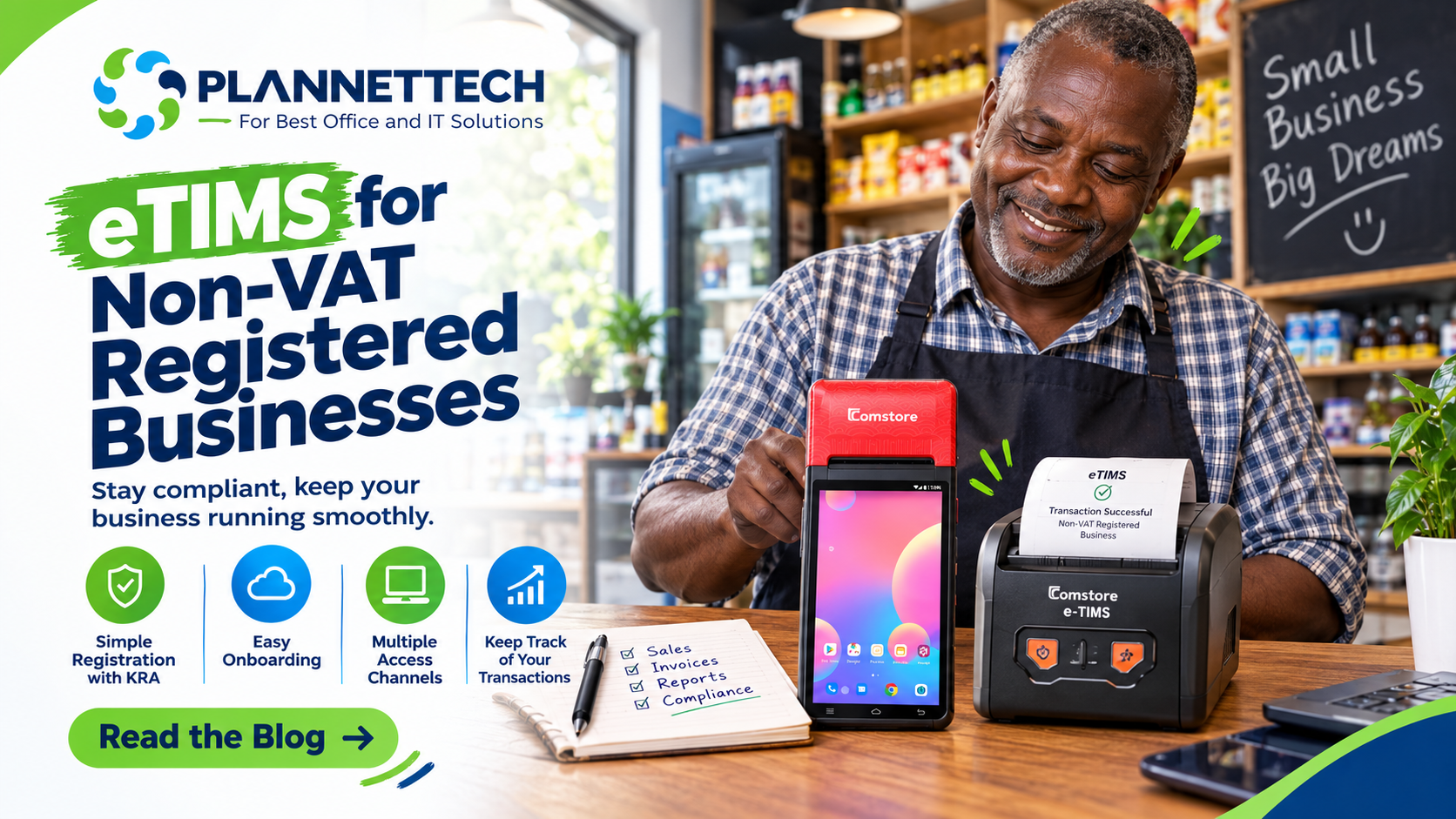
If you run a shop, salon, school, consultancy, hardware store, or any growing small business in Kenya and you have never registered for VAT, someone has probably told you, “eTIMS is only for big VAT businesses.” That belief is outdated. eTIMS for non-VAT registered businesses is now a normal part of trading in Kenya, and ignoring it can quietly raise your tax bill, cost you corporate customers, and expose you to Kenya Revenue Authority (KRA) penalties.
This guide explains eTIMS for non-VAT registered businesses in plain language. You will learn what the system is, why KRA extended it to small taxpayers, which eTIMS Lite option suits your business, how to register, how to issue your first invoice, and what to do when suppliers refuse to give you an eTIMS invoice. We also cover penalties, common mistakes, and a detailed FAQ for micro and small enterprises (MSEs) and small and medium enterprises (SMEs).
In short: eTIMS for non-VAT registered businesses means you must generate and transmit your sales invoices to KRA electronically, and you should insist that your own purchases are backed by eTIMS invoices so your expenses remain tax-deductible. The good news is that KRA built free, simple tools for exactly this purpose.
What Is eTIMS? A Plain-English Explanation
eTIMS stands for the electronic Tax Invoice Management System. It is KRA’s cloud-based platform that lets a business create a tax invoice, send it to KRA in real time, and keep a digital record of every sale. For VAT-registered traders, it replaced the old electronic tax register (ETR) boxes, and for eTIMS for non-VAT registered businesses, it offers lighter tools that work on a phone, a web browser, or even a basic handset.
The idea behind the system is simple. When a seller issues an invoice through eTIMS, KRA sees the transaction immediately, and the buyer receives an invoice that can be validated. For eTIMS for non-VAT registered businesses, this also means a clean digital trail that supports your income tax return, your expense claims, and your credibility with larger clients. If you want a deeper comparison with the older devices, read our guide on ETR machine vs eTIMS in Kenya.
Does eTIMS Apply If You Are Not Registered for VAT?
Yes. KRA has been clear that eTIMS for non-VAT registered businesses is not optional. Using its powers under Section 23A of the Tax Procedures Act, the Commissioner issued a notice requiring all persons carrying on business, including those not registered for VAT, to generate and transmit invoices through eTIMS from 1 September 2023, as summarised by EY. The rule applies to the informal sector, small traders and professionals alike.
The table below shows how the rules for eTIMS for non-VAT registered businesses developed over time.
| Date | Development | What it meant for non-VAT businesses |
|---|---|---|
| 1 Feb 2023 | eTIMS goes live | Mainly aimed at VAT-registered taxpayers |
| 1 Sept 2023 | Section 23A notice takes effect | All businesses, VAT or not, must issue eTIMS invoices |
| 1 Jan 2024 | Expense deductibility rule | Expenses without a valid eTIMS invoice are not deductible for income tax |
| 31 Mar 2024 | Penalty-free onboarding window ends | Non-VAT taxpayers had to capture manual invoices issued since 1 Jan 2024 |
| 2024 onward | eTIMS Lite launched | Web, USSD and mobile app options for small and micro taxpayers |
| 2026 | Stronger data matching | KRA compares returns against eTIMS data more closely |
Because tax rules change, always confirm the latest position on the official KRA eTIMS page before making decisions. That caution is especially important for eTIMS for non-VAT registered businesses, because new Finance Acts keep tightening how eTIMS invoices support deductions.
Who Counts as a Non-VAT Registered Business?
A non-VAT registered business is simply one that is not registered for Value Added Tax. In Kenya, VAT registration is generally required once taxable supplies reach KES 5 million in a year, so most MSEs and many SMEs fall below that line. Understanding who qualifies is the first step in applying eTIMS for non-VAT registered businesses correctly.
KRA’s own FAQ also lists businesses that are not required to register for VAT because they supply VAT-exempt goods or services, such as hospitals, schools, tour and travel agents, and NGOs that are in business. These entities still fall under eTIMS for non-VAT registered businesses. Typical examples include:
- Small retail shops, kiosks and mama mbogas selling below the VAT threshold
- Salons, barbershops, cybercafés and mobile money agents
- Freelancers, consultants, designers and other service providers
- Boda boda operators, small transporters and caterers
- Schools, clinics and NGOs that earn business income
- Online sellers and social media traders
Why eTIMS Matters Even If You Do Not Charge VAT
Many owners ask what they gain from eTIMS for non-VAT registered businesses if they do not charge or claim VAT. The answer is that eTIMS is no longer only a VAT tool. Since 1 January 2024, expenses must be supported by a valid electronic tax invoice to be deductible for income tax, so the system now affects everyone who files a return.
There are four practical reasons to take eTIMS for non-VAT registered businesses seriously:
- Lower tax bills. Deductible expenses reduce taxable profit, but only when supported by eTIMS invoices.
- Access to bigger customers. Companies and government suppliers increasingly refuse to pay vendors who cannot issue eTIMS invoices.
- Cleaner records. Every sale is logged automatically, which helps with budgeting, stock control and loan applications.
- Fewer penalties and audits. Matching invoices to returns makes mistakes harder to hide, so early compliance protects you.
For MSEs especially, eTIMS for non-VAT registered businesses is also a competitive advantage. A trader who issues professional digital invoices looks more reliable than one who writes receipts by hand, and that trust often translates into repeat orders.
The eTIMS Solutions Available to Non-VAT Businesses
KRA offers several tools, but eTIMS for non-VAT registered businesses is mainly served by the eTIMS Lite family. KRA describes these as simplified solutions tailor-made for small and micro taxpayers who are not registered for VAT. A taxpayer should not already be using another eTIMS software when choosing a Lite option.
The comparison table below helps you match each tool to eTIMS for non-VAT registered businesses of different sizes.
| Solution | How you access it | Internet needed? | Best for |
|---|---|---|---|
| eTIMS Lite (Web) | eCitizen KRA portal | Yes | Service providers with few transactions |
| eTIMS Lite (USSD) | Dial *222# | No | Sole proprietors, mama mbogas, boda boda riders |
| eTIMS Lite (Mobile App) | Play Store or App Store as “eTIMS Non VAT” | Yes | Small traders who invoice from a smartphone |
| eTIMS Client | Windows, Android tablet or PDA software | Yes | Growing SMEs selling goods from one or more branches |
| eTIMS Online Portal | Web portal at etims.kra.go.ke | Yes | Businesses supplying services only, or integrating an invoicing system |
For most owners, eTIMS for non-VAT registered businesses begins and ends with Lite, which costs nothing to use. Once your volume grows, an eTIMS Client or an integrated point-of-sale system becomes more practical, a point we return to later in this guide.
How to Choose the Right Option for Your Business
Choosing the correct tool matters because eTIMS for non-VAT registered businesses should save time, not create new headaches. A good rule is to match the solution to your transaction volume, your product type, and your internet access. If you sell five or ten items a day, a phone-based option is usually enough.
The table below gives practical guidance on eTIMS for non-VAT registered businesses across common business types.
| Business type | Typical daily invoices | Suggested option |
|---|---|---|
| Market stall or kiosk | 5 to 20 | eTIMS Lite USSD or mobile app |
| Salon, barber or cybercafé | 10 to 40 | eTIMS Lite mobile app |
| Freelancer or consultant | 1 to 5 | eTIMS Lite Web or online portal |
| Small shop with stock | 30 to 100 | eTIMS Client with stock management |
| Growing SME with several staff | 100 or more | eTIMS Client or POS integrated with eTIMS |
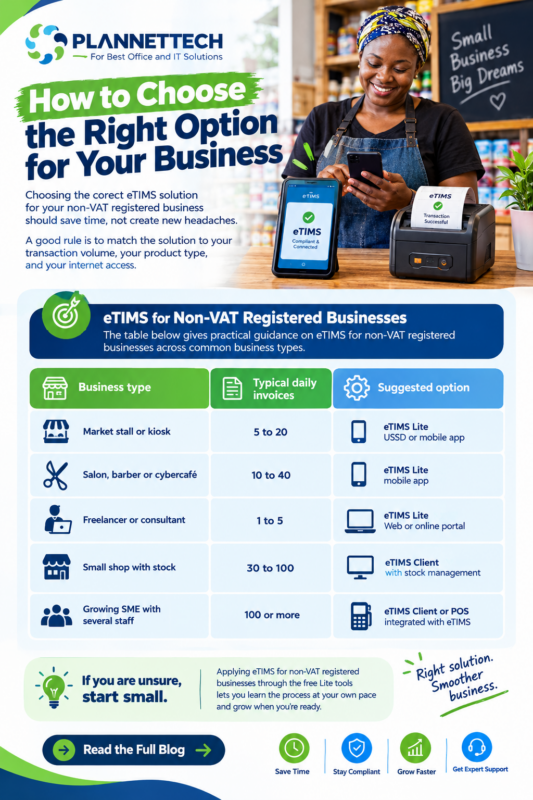
If you are unsure, start small. Applying eTIMS for non-VAT registered businesses through the free Lite tools lets you learn the process first, and you can upgrade when your sales justify it.
Step-by-Step: How to Register for eTIMS
Registration is a self-service process because KRA removed the need for officer approval so taxpayers can onboard themselves. The steps for eTIMS for non-VAT registered businesses are straightforward, but you must prepare a few things first. Make sure your KRA PIN is active and that the mobile number on your iTax profile is one you can access, since the one-time password (OTP) goes there.
Follow these steps to set up eTIMS for non-VAT registered businesses:
- Confirm your iTax details. Log in to iTax and update your phone number if it is outdated.
- Activate promotional messages on your phone; otherwise, the OTP may not arrive.
- Choose your channel. Use eCitizen for the web version, dial *222# for USSD, or install the “eTIMS Non VAT” app.
- Verify your PIN with the OTP sent to your registered number.
- Complete the business profile by describing the goods or services you sell.
- Register your items (products or services) with prices so invoices are quick to create.
- Test with a sample invoice before using it with real customers.
KRA publishes official guides, including the eTIMS Taxpayer Guidelines, which walk through each screen. Reading them once will make eTIMS for non-VAT registered businesses much less intimidating.
How to Issue an eTIMS Invoice Day to Day
Once you are onboarded, the daily routine of eTIMS for non-VAT registered businesses takes under a minute per sale. You select the item or service, enter the quantity, add the buyer’s PIN if they are a business, and submit. The system transmits the invoice to KRA and gives you a document you can share by SMS, print or show on screen.
USSD users have a particular advantage, because invoicing via *222# does not need internet, according to KRA’s FAQ at kra.go.ke. That makes eTIMS for non-VAT registered businesses realistic even in areas with weak data coverage. A few habits keep your records healthy:
- Issue the invoice at the time of sale, not at the end of the week
- Always ask corporate buyers for their KRA PIN so it appears on the invoice
- Cancel and credit properly when a sale is returned or corrected
- Keep a monthly summary of invoices for your return
If you missed invoices issued manually since 1 January 2024, KRA’s guidance was that such invoices and receipts should be captured on the system after onboarding. Doing this is part of responsible eTIMS for non-VAT registered businesses and avoids gaps during audits.
The Buyer Side: Getting eTIMS Invoices from Your Suppliers
Most owners think eTIMS for non-VAT registered businesses is only about selling, but the purchasing side is just as important. An expense is generally deductible for income tax only if it is supported by an eTIMS invoice, so a supplier who gives you a handwritten receipt may cost you real money at tax time.
To protect yourself under eTIMS for non-VAT registered businesses, build these habits into your buying:
- Tell suppliers your KRA PIN before they invoice you
- Check that the invoice carries a valid eTIMS reference or QR code
- Prefer suppliers who are onboarded, and keep their details on file
- Photograph or save every invoice and match it against payments
Where a supplier is exempt, or where the law expressly provides otherwise, special rules may apply, so confirm with a tax professional. In general, though, eTIMS for non-VAT registered businesses works best when your whole supply chain is compliant.
Common Mistakes Small Businesses Make
Because eTIMS for non-VAT registered businesses is relatively new to many MSEs, the same errors appear again and again. Fixing them early saves money and stress. The most frequent problems are listed below.
- Assuming you are exempt. Not being VAT-registered does not exempt you from eTIMS for non-VAT registered businesses.
- Using the wrong solution. Installing an eTIMS Client when Lite is enough, or the reverse, wastes time.
- Outdated phone number on iTax. No OTP means no registration.
- Skipping buyer PINs. A corporate customer cannot claim the expense without it.
- Mixing personal and business payments. This makes reconciling eTIMS data with M-Pesa statements difficult.
- Ignoring supplier invoices. Under eTIMS for non-VAT registered businesses, unsupported expenses can be disallowed.
A short monthly review, comparing your eTIMS sales report with your cash book and mobile money statement, catches most of these issues before KRA does.
When to Upgrade from eTIMS Lite to a POS or ETR-Integrated System
The free Lite tools are ideal at first, yet eTIMS for non-VAT registered businesses becomes harder to manage manually once you serve dozens of customers a day or hold many stock items. At that point, typing every invoice slows the counter and increases errors. A point-of-sale (POS) system that is already connected to eTIMS can generate compliant invoices, track inventory, and print receipts in seconds.
Businesses that reach this stage often choose hardware and software together. Plannettech supplies POS systems, receipt and label printers and office stationery that help small teams run eTIMS for non-VAT registered businesses without chaos. If you want a recommendation for your sector, you can contact Plannettech and describe your daily sales volume.
eTIMS, Returns and Turnover Tax
The link between eTIMS for non-VAT registered businesses and your annual return is closer than ever. Many small traders pay turnover tax, which at the time of writing is charged at 1.5 percent of gross turnover for qualifying businesses with annual turnover between KES 1 million and KES 25 million. Because eTIMS records every invoice, your reported turnover can be checked against what you transmitted.
That is why eTIMS for non-VAT registered businesses should be treated as part of your bookkeeping, not a separate chore. Reports from eTIMS can be exported or summarised monthly, so your return is a matter of copying verified totals. Rates and thresholds can change through Finance Acts, so check current figures on KRA’s website before filing.
VAT-Registered vs Non-VAT Businesses: What Changes?
It helps to see where eTIMS for non-VAT registered businesses differs from the VAT version of the system. The core duty, issuing electronic invoices, is the same, but the tools and tax treatment differ.
| Feature | VAT-registered business | Non-VAT registered business |
|---|---|---|
| Must issue eTIMS invoices | Yes | Yes |
| Charges VAT on invoices | Yes | No |
| Can claim input VAT | Yes, with eTIMS invoices | Not applicable |
| Typical tools | eTIMS Client, online portal, VSCU/OSCU, POS integration | eTIMS Lite (web, USSD, app) or eTIMS Client |
| Expense deductibility rule | Needs eTIMS invoices | Needs eTIMS invoices |
Notice that the last row is identical. This is why eTIMS for non-VAT registered businesses is about income tax compliance, even when VAT is not in the picture.
Penalties and Risks of Ignoring eTIMS
KRA has moved from awareness campaigns toward enforcement, so eTIMS for non-VAT registered businesses carries real risk if neglected. The most common consequence is the disallowance of expenses, which raises taxable profit. Failure to issue invoices can also attract penalties under the Tax Procedures Act, and the Finance Act 2026 was reported to strengthen the requirement to support deductible expenses with eTIMS-generated invoices.
Penalty amounts depend on the section applied, and your type of taxpayer, and published figures vary, so we recommend verifying them on KRA’s official channels rather than relying on rumours. The safest approach to eTIMS for non-VAT registered businesses is to onboard now, issue invoices consistently and keep clean records. KRA has also run amnesty programmes for older tax debts, so speak to a tax adviser if you already have arrears.
Quick Compliance Checklist for MSEs and SMEs
Use this checklist to confirm that eTIMS for non-VAT registered businesses is working properly in your operation:
- KRA PIN active and iTax phone number up to date
- Registered on the correct eTIMS Lite or Client solution
- Items and prices loaded on the system
- Staff trained to issue invoices at the point of sale
- Suppliers informed of your KRA PIN
- Monthly reconciliation of eTIMS sales and purchases
- Backup of invoices and expense evidence
Ticking every box means eTIMS for non-VAT registered businesses is under control, and your next tax return will be far easier to prepare.
Frequently Asked Questions About eTIMS for Non-VAT Registered Businesses
Is eTIMS mandatory for non-VAT registered businesses in Kenya?
Yes. KRA requires all persons carrying on business, including those not registered for VAT, to generate and transmit invoices electronically, so eTIMS for non-VAT registered businesses is a legal requirement and not a voluntary option. The obligation took effect on 1 September 2023.
What is eTIMS Lite?
eTIMS Lite is the simplified version designed for eTIMS for non-VAT registered businesses. It comes in three forms: a web version on eCitizen, a USSD version on *222# and a mobile app called eTIMS Non VAT. All are free to use.
How do I register for eTIMS if I am not VAT registered?
To start eTIMS for non-VAT registered businesses, confirm your iTax mobile number, activate promotional messages, then verify your PIN with the OTP on eCitizen, USSD or the mobile app. After that, add your items and begin invoicing.
Can I use eTIMS without internet?
Yes, through USSD. KRA states that invoicing via *222# needs no internet, which makes eTIMS for non-VAT registered businesses practical for traders in areas with poor connectivity, although a normal mobile network is still required.
Does eTIMS cost money?
The eTIMS Lite solutions are free from KRA, so eTIMS for non-VAT registered businesses can start at no cost. You may spend money later on a smartphone, a printer or a POS system if your volume grows.
What happens if my supplier does not give me an eTIMS invoice?
Your expense may be disallowed for income tax, which defeats the purpose of eTIMS for non-VAT registered businesses on the buying side. Ask for a compliant invoice with your KRA PIN or consider another supplier.
Do I need an eTIMS invoice for very small sales?
The rule is intended to cover business transactions generally, so eTIMS for non-VAT registered businesses applies even to small sales. Where the law gives a specific exemption, KRA’s guidance applies, so confirm with KRA or a tax adviser.
Can I switch from eTIMS Lite to eTIMS Client later?
Yes, as your business grows. Many owners begin eTIMS for non-VAT registered businesses on Lite and later move to an eTIMS Client or a POS system, but note that Lite is meant for taxpayers who are not using other eTIMS software.
Is an eTIMS invoice the same as a receipt?
An eTIMS invoice is the official electronic document transmitted to KRA, and under eTIMS for non-VAT registered businesses, it serves as proof of the sale for both buyer and seller. A plain handwritten receipt does not carry the same weight.
What is the difference between eTIMS and an ETR machine?
An ETR is a physical fiscal device, while eTIMS is a software system. For eTIMS for non-VAT registered businesses, software options are cheaper and simpler, which is why KRA promotes them for small taxpayers.
What penalties apply if a non-VAT business ignores eTIMS?
You risk disallowed expenses, higher tax, and possible penalties under the Tax Procedures Act. Because exact amounts vary, treat eTIMS for non-VAT registered businesses as a compliance priority and check current penalty details with KRA.
Where can I get help setting up eTIMS?
KRA offers user guides and support, and technology suppliers can help with devices and software. For hands-on help with eTIMS for non-VAT registered businesses, including POS systems and printers, you can speak to the Plannettech team.
Conclusion: Make eTIMS Work for Your Business
The direction of travel is clear: eTIMS for non-VAT registered businesses is now part of normal operations for every Kenyan trader, whatever their size. The sooner you onboard, the sooner you protect your deductions, win bigger customers, and avoid penalties. Start with the free eTIMS Lite option, build the habit of issuing and requesting invoices, and upgrade your tools as your sales grow.
If you need reliable hardware and software to support eTIMS for non-VAT registered businesses, explore the Plannettech POS and office technology range or get in touch for personalised advice. Compliance does not have to be complicated when you choose the right tools from the start.
This article is for general information and is not tax or legal advice. Rules and penalties may change, so confirm current requirements with KRA or a qualified tax adviser.
Sources and further reading: KRA eTIMS · KRA eTIMS FAQs · eTIMS Taxpayer Guidelines (PDF) · EY tax alert on non-VAT onboarding · KPMG alert on eTIMS Lite