


Best POS System with eTIMS Kenya: The Complete 2026 Guide for MSEs and SMEs

If you run a shop, pharmacy, restaurant, or supermarket anywhere in Kenya, you have probably already heard that a manual receipt book is no longer good enough. KRA now expects every sale to be captured electronically, and that is exactly why so many business owners are searching for the right POS system with eTIMS in Kenya. This guide walks you through what eTIMS actually is, why it matters for both MSEs (Micro and Small Enterprises) and SMEs (Small and Medium Enterprises), and how to choose a POS system with eTIMS Kenya businesses can rely on every single day without slowing down the counter or confusing your staff.
What Is eTIMS and Why Does It Matter for Your POS?
eTIMS stands for the Electronic Tax Invoice Management System, and it is KRA’s platform for capturing every sale in real time. When you pair it with a POS system with eTIMS integration in Kenya, every transaction at the till is transmitted straight to KRA the moment it happens, instead of being written on a paper receipt that could get lost, altered, or ignored at tax time. According to KRA’s official eTIMS guidance, businesses can onboard through several channels depending on their size, which is precisely why choosing the right POS system with eTIMS Kenya-wide is not a one-size-fits-all decision. A supermarket with ten tills has very different needs from a single-owner boutique, and the eTIMS solution built into your POS should match your business, not the other way around.
Why Every MSE and SME in Kenya Needs a POS System with eTIMS
The days of treating eTIMS as optional are over. Whether you are a market-stall trader classified as an MSE or a growing retail chain that counts as an SME, KRA now cross-checks declared income and expenses against eTIMS records, which means a POS system with eTIMS Kenya authorities recognize is no longer a “nice to have”; it is how you protect your business from disallowed deductions and audit flags. For MSEs especially, a lightweight POS system with eTIMS support can be the difference between spending hours reconciling handwritten books and having accurate, KRA-ready records generated automatically at the point of sale. For SMEs running multiple branches or higher transaction volumes, a full POS system with eTIMS Kenya vendors configured for OSCU or VSCU integration removes the manual invoice-matching headache entirely.
It also matters because of who is on the other side of your transactions. If you sell to other registered businesses, your customers can only claim their purchase from you as a deductible expense if it comes with a valid eTIMS invoice. That means an MSE or SME without a working POS system with eTIMS Kenya setup risks quietly losing B2B customers who move to a supplier that can issue compliant invoices. In practice, this makes a POS system with eTIMS integration less of a tax formality and more of a competitive requirement for staying attractive to business buyers.
The Real Cost of Not Having a POS System with eTIMS
Skipping eTIMS compliance is not a passive choice; it carries active financial risk. Businesses that fail to issue an electronic tax invoice can face a penalty of double the tax due, or a minimum penalty in the region of Ksh 100,000, and non-compliant businesses are also more likely to be flagged for detailed KRA audits. For an MSE running on thin margins, that kind of penalty can be devastating; for an SME with several branches, the audit disruption alone can cost far more in staff time than the POS system with eTIMS Kenya hardware would have cost in the first place. Framed this way, a POS system with eTIMS purchase is not really an expense — it is insurance against a much higher, avoidable cost down the line.
How a POS System with eTIMS Actually Works
A properly integrated POS system with eTIMS in Kenya does three things at once: it rings up the sale, prints or sends the customer’s receipt, and transmits the tax invoice data to KRA all in the same motion the cashier is already making. Depending on your VAT status, this happens through one of a few recognized channels. Non-VAT micro and small taxpayers typically use eTIMS Lite, which KRA makes available through the eCitizen portal, USSD (*222#), or a mobile app, as confirmed on KRA’s onboarding page. VAT-registered SMEs, on the other hand, usually need a POS system with eTIMS Kenya suppliers configured for OSCU (Online Sales Control Unit) or VSCU (Virtual Sales Control Unit) integration, which links the till software directly to KRA’s servers. Either way, the goal of a good POS system with eTIMS setup is the same: zero manual re-entry and zero risk of a sale slipping through untaxed.
POS System with eTIMS vs. Traditional ETR Machines
Many older businesses in Kenya are still running the traditional ETR (Electronic Tax Register) machines they bought years ago, and it’s worth understanding why these are being phased out in favor of a proper POS system with eTIMS integration. A standalone ETR machine only prints a receipt; it does not connect to your inventory, does not track sales by product, and does nothing to help you manage staff or stock. A modern POS system with eTIMS Kenya businesses are switching to does everything the old ETR did, plus real-time KRA transmission, inventory control, barcode scanning, and sales reporting, all from one till. For an MSE upgrading from a manual receipt book, or an SME retiring an aging ETR machine, moving to a combined POS system with eTIMS solution consolidates two separate problems tax compliance and till management into a single piece of hardware.
Key Features to Look for in a POS System with eTIMS in Kenya
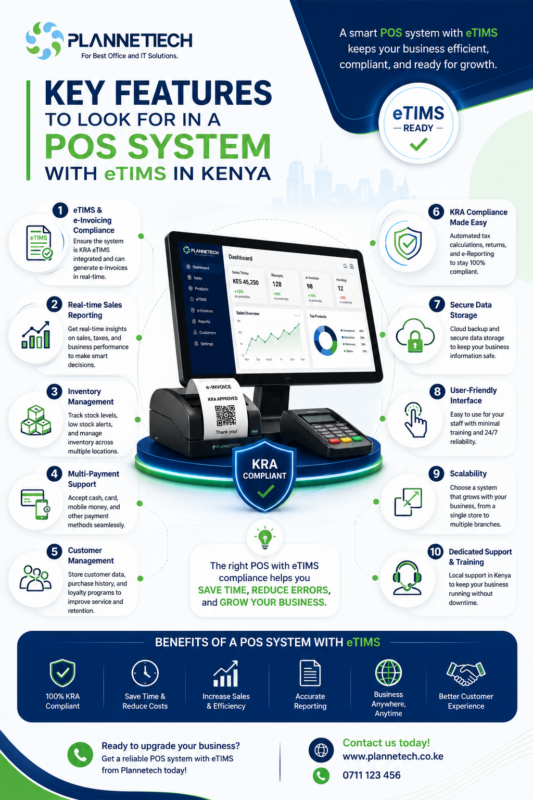
Not every till software marketed locally is truly built for compliance. Before you buy, check that the POS system with eTIMS Kenya vendor is offering actually includes real-time invoice transmission, not a manual export you have to upload later. A dependable POS system with eTIMS integration should also offer offline resilience. Kenya’s internet is not always perfect, so the system needs to queue invoices and sync automatically once connectivity returns. Look for barcode scanning and inventory tracking built in, since most MSEs and SMEs buying a POS system with eTIMS Kenya-wide also want to control stock, not just print receipts. Finally, confirm the hardware itself the touchscreen terminal, printer, and scanner is durable enough for daily counter use; a POS system with eTIMS capability is only useful if the machine survives the shop floor.
Benefits of Switching to a POS System with eTIMS Integration
Beyond compliance, there are practical, day-to-day reasons MSEs and SMEs across Kenya are switching to a proper POS system with eTIMS Kenya setup. It speeds up closing time because sales, stock, and tax records reconcile automatically instead of being tallied by hand at the end of the day. It reduces staff errors, since a POS system with eTIMS terminal calculates totals and taxes consistently instead of relying on manual arithmetic at a busy counter. It also gives owners real visibility into the business. Most POS system with eTIMS Kenya software includes basic sales reporting, so you can see which products are moving and which are not, without waiting for a monthly reconciliation. For businesses that already use accounting software, a well-integrated POS system with eTIMS setup can feed sales data straight into your books, cutting down the double-entry work your accountant would otherwise have to do. If you want to see how POS-level payment integration fits into the wider picture of running a modern till, Plannettech’s earlier post on POS payment integration is a useful companion read alongside this guide.
Plannettech’s POS Systems with eTIMS Integration
Plannettech Investors Limited supplies several options for businesses looking for a reliable POS system with eTIMS Kenya-wide, all sourced and configured for the Kenyan market. The P10S Android POS Terminal is a compact, KRA eTIMS-compatible terminal with a built-in 58mm thermal printer, making it one of the more affordable entry points for an MSE that wants a genuine POS system with eTIMS capability without investing in a full desktop rig. For businesses that need more processing power, Plannettech’s all-in-one POS terminals support full POS software stacks alongside barcode scanners, receipt printers, and cash drawers, ideal for an SME running a POS system with eTIMS Kenya compliance requirements across a busier till. If you serve walk-in customers who want to see the bill as it’s rung up, the dual-screen POS terminal adds a customer-facing display to the same eTIMS-ready setup. You can browse the full range in Plannettech’s POS systems and hardware shop to compare specs before deciding which POS system with eTIMS configuration suits your counter.
Choosing a POS System with eTIMS by Business Type
Different businesses need their POS system with eTIMS Kenya setup configured differently. A pharmacy needs a POS system with eTIMS integration that also tracks drug batches and expiry dates alongside every eTIMS-compliant sale. A supermarket needs a POS system with eTIMS Kenya that supermarkets can trust to handle high transaction volumes across multiple tills without lag. A restaurant or bar needs a POS system with eTIMS integration that can split bills, manage table orders, and still transmit a compliant invoice for every item sold. Boutiques and salons, meanwhile, often just need a lean POS system with eTIMS Kenya solution that handles lower volumes without unnecessary complexity. Plannettech’s Android POS range is a good starting point for smaller operations, while larger businesses may prefer the higher-spec all-in-one terminals for a more demanding POS system with eTIMS workload.
How Much Does a POS System with eTIMS Cost in Kenya?
Pricing for a POS system with eTIMS Kenya businesses can afford varies mainly by hardware specification rather than the eTIMS capability itself, since KRA’s own eTIMS software (the online portal and Client solution) is free to use. What you are really paying for when you buy a POS system with eTIMS terminal is the processor, screen, printer, and build quality of the machine that runs it. Plannettech’s entry-level Android terminals sit at the more affordable end, while full Windows-based all-in-one units with higher specifications cost more but suit busier SMEs. Whichever tier you choose, remember that a cheap POS system with eTIMS Kenya vendors cannot properly support will end up costing more in downtime and lost sales than a slightly pricier, more reliable unit.
How to Set Up Your POS System with eTIMS in Kenya
Getting a POS system with eTIMS Kenya-compliant and running involves a few clear steps. First, register for eTIMS itself. KRA’s step-by-step onboarding guide explains the registration process before any solution can be installed. Second, decide which eTIMS channel fits your business: eTIMS Lite for non-VAT MSEs, or OSCU/VSCU integration for VAT-registered SMEs running a full POS system with eTIMS setup. Third, install and configure your chosen POS system with eTIMS Kenya hardware, making sure the software is actually linked to your KRA PIN and tested with a sample invoice before you rely on it for real transactions. Plannettech provides installation support for its terminals, which is worth asking about if your team is not confident configuring a POS system with eTIMS integration on their own.
Common Mistakes Businesses Make When Choosing a POS System with eTIMS
The most common mistake is assuming any till software is automatically a compliant POS system with eTIMS Kenya solution; many are not, and only generate a printed receipt without transmitting anything to KRA. Another mistake is buying a POS system with eTIMS terminal that is underpowered for the business’s actual transaction volume, leading to slow checkout lines during peak hours. Some MSEs also delay adopting a POS system with eTIMS Kenya setup altogether, assuming manual records are still acceptable, but as tax guidance increasingly makes clear, unsupported expenses without an eTIMS invoice are treated as taxable profit, which can be a costly surprise at filing time. Finally, businesses sometimes skip testing their POS system with eTIMS integration before go-live, only to discover connectivity or configuration issues on a busy trading day.
FAQs About POS Systems with eTIMS in Kenya
1. Is a POS system with eTIMS mandatory for all businesses in Kenya? Yes. KRA now requires all businesses, including MSEs and SMEs regardless of VAT status, to issue electronic tax invoices, which means adopting some form of POS system with eTIMS Kenya compliance is effectively unavoidable for anyone selling goods or services.
2. What is the difference between eTIMS Lite and a full POS system with eTIMS integration? eTIMS Lite is KRA’s simplified option for non-VAT micro and small taxpayers, accessible via eCitizen, USSD, or a mobile app. A full POS system with eTIMS setup using OSCU or VSCU integration is generally needed by VAT-registered SMEs with higher transaction volumes or multiple tills.
3. Can I use my existing till and just add eTIMS? Sometimes, if your current software supports integration. Otherwise, most businesses find it simpler to move to a dedicated POS system with eTIMS. Kenya vendors have already configured and tested for compliance, rather than retrofitting older equipment.
4. How much does a POS system with eTIMS cost in Kenya? Cost depends on the hardware tier you choose, since KRA’s own eTIMS software is free. A basic POS system with eTIMS terminal like Plannettech’s P10S is more affordable, while full all-in-one units cost more but suit busier SMEs.
5. Does a POS system with eTIMS work without internet? Good systems are built to queue invoices offline and sync once connectivity is restored, so a reliable POS system with eTIMS Kenya businesses use should not stop working during a brief network outage.
6. Where can I buy a POS system with eTIMS in Kenya? Plannettech Investors Limited supplies eTIMS-ready POS terminals, including the P10S Android POS Terminal and full all-in-one units, with installation support included.
7. Is a POS system with eTIMS the same as ordinary POS software? Not always. Plenty of POS software sold in Kenya only prints receipts and does not transmit anything to KRA. A genuine POS system with eTIMS Kenya solution must actually connect to KRA’s servers (via OSCU, VSCU, or eTIMS Lite), so it’s worth confirming this specifically with any vendor before buying.
8. What happens if my POS system with eTIMS integration goes offline? A well-built POS system with eTIMS setup will continue recording sales locally and queue the invoices for transmission once connectivity is restored, rather than blocking transactions or losing data during short outages.
Final Thoughts
Choosing the right POS system with eTIMS in Kenya is no longer just about speeding up checkout; it is about protecting your business from penalties, audit risk, and lost B2B customers who can no longer claim your invoices without a valid eTIMS receipt. Whether you are an MSE just getting started with a lightweight terminal or an SME scaling across multiple branches, the right POS system with eTIMS Kenya setup should fit your transaction volume, your budget, and your compliance obligations at the same time. Browse Plannettech’s full range of POS systems and hardware to find the right eTIMS-ready terminal for your business, or reach out to the team for guidance on which POS system with eTIMS integration best suits your setup.