


What Is an ETR Machine? A Simple Guide for Kenyan Business Owners

If you run a shop, restaurant, salon, hardware store, or any other business in Kenya, you have probably heard the term “ETR machine” thrown around by your accountant, a KRA official, or a fellow business owner. Maybe someone told you that you need one before you can legally issue a receipt. Maybe you already own one and are not entirely sure how it fits into today’s tax rules. This guide breaks down, in plain language, what an ETR machine is, how it works, who needs one, and how the rules have changed in recent years. By the end, you will understand exactly what an ETR machine does for your business and how to get compliant without the confusion.
What Is an ETR Machine?
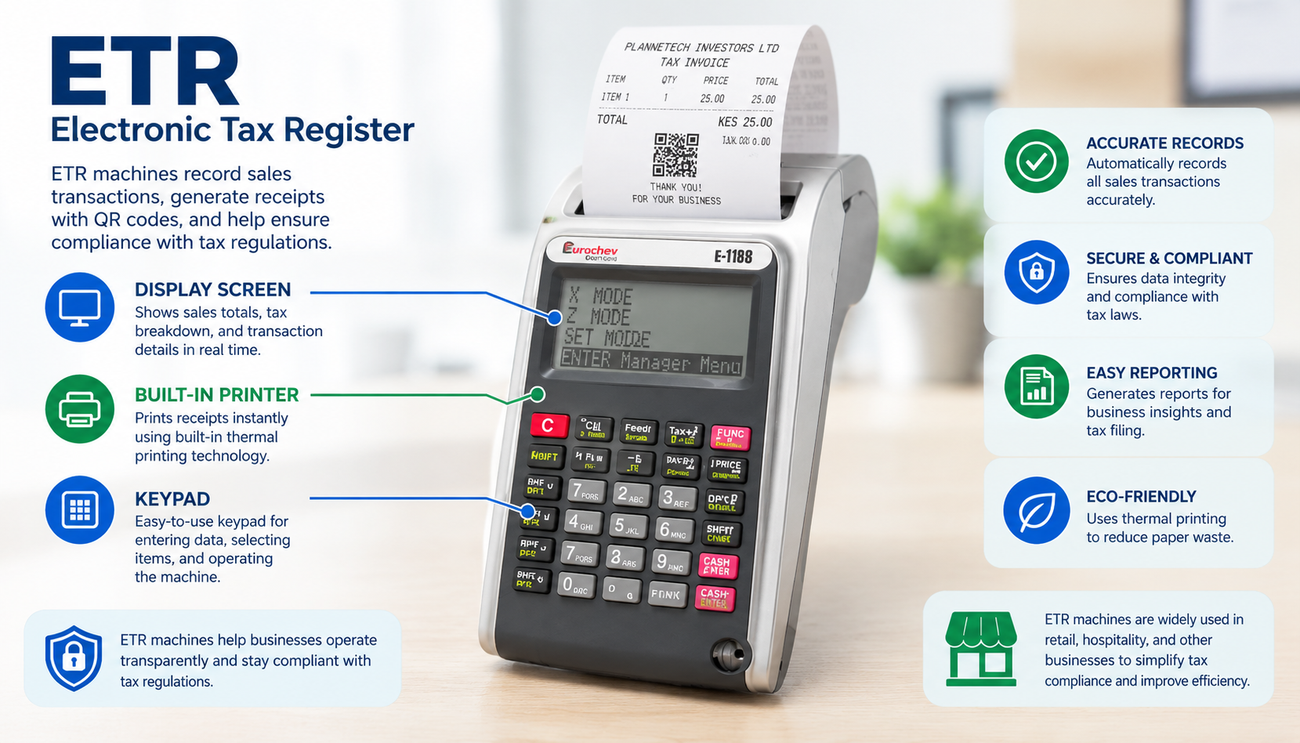
An ETR machine, short for Electronic Tax Register machine, is a KRA-approved device or system that records every sale a business makes and generates a tax-compliant receipt for the customer. In simple terms, an ETR machine turns an ordinary cash sale into an official, government-recognized transaction. For close to two decades, Kenyan traders in Nairobi, Mombasa, Kisumu, and every town in between have relied on an ETR machine to print receipts that the Kenya Revenue Authority (KRA) can verify. The core idea behind an ETR machine has never changed: capture the sale, calculate the correct tax, and produce a receipt that cannot easily be altered or hidden from KRA.
Where the ETR Machine Requirement Came From
The ETR machine was introduced to solve a real problem for the Kenya Revenue Authority: businesses under-declaring their sales and, in turn, underpaying VAT. Before the ETR machine became mandatory, KRA had very little visibility into daily transactions happening in shops across the country. Once VAT-registered businesses were required to install an ETR machine, every sale left a digital trail that fed back into KRA’s tax records. This single requirement changed how retail and service businesses operated overnight, because an ETR machine meant sales figures were no longer just numbers in a notebook that could be adjusted at the end of the month.
How Does an ETR Machine Actually Work?
At a basic level, an ETR machine works like a specialized cash register with a tax brain built in. When a cashier keys in a sale, the ETR machine calculates the VAT due, stores the transaction in its internal memory, and prints a receipt with a unique serial number, the date, the item cost, and the tax charged. Older, standalone versions of the ETR machine stored this data locally and required the business to submit records to KRA periodically. Newer, connected versions of the ETR machine transmit each sale to KRA in real time the moment the transaction happens, closing the gap between what a business declares and what it actually sold. Understanding this flow is the first step to understanding why every VAT-registered entity was told to install an ETR machine in the first place.
ETR Machine vs eTIMS: What Changed?
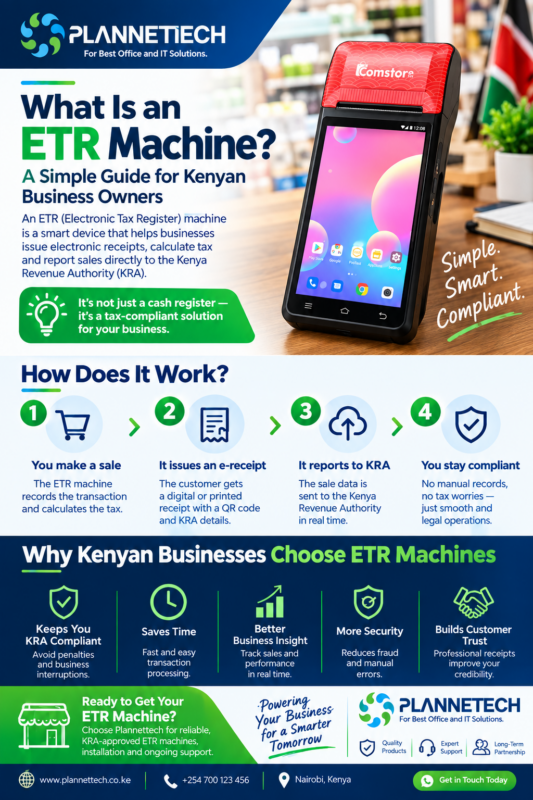
This is where most Kenyan business owners get confused, so it is worth addressing directly. An ETR machine, in its classic form, was a physical countertop device that a business bought outright and had fiscalized by an approved supplier. In 2022, KRA rolled out the Electronic Tax Invoice Management System, known as eTIMS, and began phasing out registration of new standalone ETR machine units in favor of software-based invoicing. eTIMS is the current system, and the standalone ETR machine has been phased out for new registrations, though existing users have faced pressure to migrate. In everyday conversation, however, suppliers and customers still use “ETR machine” and “eTIMS” interchangeably, because both terms point to the same underlying obligation: record every sale and send it to KRA. If you are shopping for a compliant device today, you will see it advertised both ways, and functionally it is the same compliance requirement wearing two different names.
Is an ETR Machine Still Legally Required?
Yes, in the sense that every business still needs a KRA-recognized way to record and transmit sales, even though the specific hardware called an “ETR machine” has largely given way to eTIMS-based solutions. eTIMS was introduced for VAT-registered businesses in November 2022, and by January 1, 2024, the mandate expanded to cover every business in Kenya, including those not registered for VAT. This means that whether you are a large VAT-registered supermarket or a small kiosk owner who has never registered for VAT, some form of ETR machine or eTIMS-compliant invoicing now applies to you. The days when only “big shops” needed an ETR machine are over; today the requirement touches nearly every business that issues a receipt.
Who Needs an ETR Machine in Kenya?
Practically speaking, an ETR machine or its eTIMS equivalent applies to a very wide range of businesses. Retail shops, supermarkets, restaurants, bars, salons, hardware stores, pharmacies, electronics dealers, and service providers of almost every kind fall under this requirement. An ETR is mandatory for small businesses too, since under the current income validation rules almost every business that issues receipts must record sales through a compliant system, even when it is not VAT-registered. If your business issues any kind of receipt or invoice to a paying customer, you should assume an ETR machine or an eTIMS-compliant alternative applies to you, and you should not wait for a KRA visit to find out otherwise.
Why an ETR Machine Matters for Your Bottom Line, Not Just Compliance
Many Kenyan business owners think of an ETR machine purely as a legal box to tick, but it also protects your own business finances. An expense that is not backed by a valid eTIMS invoice is disallowed for income-tax purposes, and from 2026, KRA validates returns directly against eTIMS data, so mismatches surface automatically rather than only at audit time. In other words, if your suppliers are not issuing you receipts through a proper ETR machine or eTIMS channel, you could end up paying more income tax than necessary because those costs will not count as deductible expenses. This makes an ETR machine just as important for the purchases you make as for the sales you record.
The Real Cost of Ignoring the ETR Machine Requirement
Skipping the ETR machine requirement is far more expensive than installing one. Recent legislation set penalty floors for failing to use eTIMS at a minimum of KSh 100,000 for companies and KSh 10,000 for individuals, rising to as much as KSh 1 million or 10% of the tax involved. Beyond the direct fines, a business without a working ETR machine risks blocked VAT refunds, rejected tax returns, and a damaged relationship with corporate clients who need valid receipts to claim their own expenses. For a small business owner watching margins closely, the penalty for skipping an ETR machine can wipe out months of profit in a single assessment.
Types of ETR Machines Available Today
When people search for an ETR machine, they are usually looking at one of a few categories of devices or software. The first is the classic standalone ETR machine, a dedicated hardware till with a built-in printer, still used by some older businesses who have not yet migrated. The second is eTIMS Client software, installed on a computer or tablet, which effectively acts as a software-based ETR machine without dedicated hardware. The third is a full point-of-sale system with eTIMS built in, which functions as an ETR machine while also managing stock, sales reports, and M-Pesa reconciliation in one place. The fourth is eTIMS Lite, designed for very small, non-VAT businesses that need the lightest possible version of an ETR machine, accessible through a phone or USSD code. Choosing between these options depends heavily on the size and complexity of your business.
eTIMS Lite: The Simplest ETR Machine Option for Small Traders
If you run a small kiosk, salon, or side hustle and have never registered for VAT, you do not need an expensive dedicated ETR machine to comply. KRA has provided simplified eTIMS Lite solutions tailor-made for small and micro taxpayers not registered for VAT, including eTIMS Lite Web accessible via eCitizen, eTIMS Lite USSD dialed through a short code, and an eTIMS Lite mobile app. For many small traders, this is the cheapest and fastest way to satisfy the ETR machine requirement without buying any hardware at all. It is worth checking whether your business qualifies for this lighter version before spending money on a full ETR machine setup.
How Much Does an ETR Machine Cost in Kenya?
Pricing for an ETR machine varies depending on whether you choose hardware or software. A traditional standalone ETR machine typically costs between KSh 8,000 and 20,000 upfront, plus KSh 500 to 1,000 a month, while eTIMS software options run from about KSh 1,500 to 5,000 a month with no upfront hardware cost. Over a full year, a software-based ETR machine often works out cheaper than the old hardware model, and it usually comes bundled with extra features such as sales analytics, multi-branch reporting, and M-Pesa reconciliation. When budgeting for an ETR machine, it is worth comparing the total first-year cost of a physical unit against a subscription-based alternative rather than looking only at the sticker price.
How to Register for an ETR Machine or eTIMS
Registering your business for an ETR machine today happens through KRA’s eTIMS platform rather than a standalone paper process. To comply, your business needs an active KRA PIN, and registration involves logging into the iTax portal, navigating to the eTIMS menu, choosing the solution that fits your business size, such as eTIMS Lite, eTIMS Client, or a full POS integration, and then submitting your business details. Once approved, KRA issues the credentials your chosen ETR machine or eTIMS solution needs to start transmitting invoices. If you would rather not navigate the portal alone, a supplier who has already fiscalized many ETR machine installations can usually walk you through registration in a single visit.
Setting Up Your ETR Machine After Registration
Registration is only half the journey; the ETR machine or eTIMS solution still needs to be configured correctly for your specific products and tax categories. Once you select POS Integration as your preferred eTIMS method, you download Service Initialization credentials from iTax, enter them into your point-of-sale software’s tax settings, and assign each product or service to the correct tax category before testing a sale. A correctly configured ETR machine will return a CU invoice number and a QR code from KRA on every successful test transaction, confirming that your setup is live and transmitting properly. Skipping this testing step is one of the most common reasons businesses discover, only after a KRA audit, that their ETR machine was never actually sending data.
Common Mistakes Kenyan Businesses Make With Their ETR Machine
A surprising number of compliance problems come from simple, avoidable mistakes rather than deliberate tax evasion. Some businesses buy an ETR machine but never complete the fiscalization step with KRA, leaving them technically non-compliant despite owning the right hardware. Others enter the wrong Tax Identification Number during setup, which causes every receipt from that ETR machine to be rejected on KRA’s end without the cashier noticing. A third common error is failing to categorize products correctly, so an ETR machine ends up charging the wrong VAT rate on certain items. Offline sales are allowed for a limited window before they must sync, and businesses that let devices stay offline past that window can find their invoices rejected, so leaving an ETR machine disconnected from the internet for too long is another mistake worth avoiding.
Choosing the Right ETR Machine for Your Business Type
The best ETR machine for a busy restaurant is rarely the best fit for a one-person retail stall, so it pays to match the solution to how you actually operate. A high-volume retail shop or supermarket benefits from a full POS-integrated ETR machine that handles stock control, multiple cashiers, and detailed daily reports alongside tax compliance. A small non-VAT trader is usually better served by an eTIMS Lite ETR machine accessed from a phone, since it avoids monthly software fees entirely. A growing service business, such as a salon chain or a small hardware supplier, often lands in the middle, needing an eTIMS Client-based ETR machine that is affordable but still supports multiple product categories. Before settling on any ETR machine, it helps to list how many daily transactions you process, whether you need multi-branch reporting, and whether M-Pesa reconciliation is a daily headache for your staff.
ETR Machine and M-Pesa: Solving a Common Reconciliation Headache
For many Kenyan businesses, matching M-Pesa payments to actual sales at the end of the day is one of the most frustrating parts of running a shop. A modern ETR machine that is integrated into a point-of-sale system can solve this automatically, syncing daily sales and M-Pesa payments so staff are not manually cross-checking two separate records. Businesses still using an older, disconnected ETR machine often continue to face this reconciliation problem, because the till and the mobile money statement were never designed to talk to each other. If reconciling M-Pesa payments is eating into your evenings, it is worth treating that pain point as a reason to upgrade your ETR machine rather than just a side annoyance to live with.
Buying an ETR Machine From a Trusted Supplier
Because an ETR machine must be properly fiscalized and registered with KRA before it can legally issue receipts, where you buy it matters as much as which model you choose. A trustworthy supplier will not just hand over a box; they will handle the KRA registration, configure the tax categories correctly, and train your staff on daily use of the ETR machine. Plannettech supplies KRA-compliant ETR machines and eTIMS-ready POS systems to businesses across Kenya, alongside the printers and office equipment many shops need to run day-to-day. Choosing a local supplier who understands both the hardware and the KRA registration process saves you from the common trap of owning an ETR machine that was never actually activated.
ETR Machine Maintenance and Ongoing Compliance
Buying and registering an ETR machine is not a one-time task; it requires a small amount of ongoing attention to stay compliant. Software-based ETR machine solutions need regular updates, since KRA periodically changes technical requirements for how invoices are transmitted. Hardware ETR machine units need their internal memory and printer supplies checked so that receipts keep printing correctly during busy periods. It is also worth keeping digital copies of your ETR machine’s transaction history, since KRA requires businesses to retain digital records for several years in case of an audit. Building a simple monthly checklist around your ETR machine, covering software updates, printer paper, and backup records, prevents small issues from becoming compliance emergencies.
ETR Machine Training: Getting Your Staff Ready
Even the best ETR machine will cause problems if the person operating it every day does not understand how it works. Cashiers need to know how to key in sales correctly, how to handle a return or refund through the ETR machine without breaking the tax trail, and what to do if the device shows an error code mid-transaction. Businesses that treat ETR machine training as a one-time event during installation often find that new staff members make the same avoidable mistakes months later, from entering the wrong tax category to failing to notice when the machine has silently gone offline. Building a short, written checklist for staff, covering how to open and close a day on the ETR machine, how to reprint a lost receipt, and who to call if the device stops transmitting, turns a potential compliance risk into a routine part of daily operations.
What to Do When Your ETR Machine Shows an Error
An ETR machine that suddenly rejects transactions can bring a busy till to a standstill, so it helps to know the common causes before panic sets in. A rejected invoice from an ETR machine is often caused by an incorrect Tax Identification Number, a mismatched tax code on a product, or a duplicate invoice number being submitted twice. In most cases, correcting the underlying detail and retransmitting the sale through the ETR machine resolves the issue immediately, without needing to contact KRA directly. If the ETR machine continues rejecting valid sales after these checks, the next step is to contact your supplier’s support line or KRA’s own helpdesk, since a persistent error usually points to a deeper configuration or connectivity problem rather than a one-off mistake.
Frequently Asked Questions About the ETR Machine
Is an ETR machine the same as eTIMS? Not exactly, but they cover the same requirement. The classic ETR machine was standalone hardware, while eTIMS is the current, broader system that includes software options; in casual use, people still call any compliant device an ETR machine.
Do small businesses without VAT registration need an ETR machine? Yes. Non-VAT businesses are expected to use a lighter version of the ETR machine requirement, typically through eTIMS Lite, rather than a full standalone unit.
How long does it take to register an ETR machine? Once your KRA PIN is active, registering the eTIMS side of an ETR machine can often be completed online in one sitting, though full activation depends on the solution you choose and how quickly your details are verified.
Can an ETR machine work without internet access? Some POS-integrated ETR machine setups support a short offline window with automatic sync once the connection returns, but relying on this for long periods risks rejected invoices.
What happens if my ETR machine breaks down? You should contact your supplier immediately to repair or replace the unit, since operating without a working ETR machine, even temporarily, exposes your business to the same penalties as never having one at all.
Final Thoughts on Choosing and Using an ETR Machine
An ETR machine is no longer just a piece of till hardware gathering dust in the corner of a shop; it is now a core part of how Kenyan businesses stay compliant, protect their deductible expenses, and avoid steep penalties. Whether you end up with a classic standalone ETR machine, a software-based eTIMS Client, or a full POS system with eTIMS built in, the underlying goal is the same: record every sale accurately and get that data to KRA without gaps. Take the time to match the right ETR machine to your business size, register it properly through KRA’s official channels, and keep it maintained, and it will quietly protect your business rather than becoming a source of stress at tax time.
For official guidance on registration and requirements, refer to KRA’s eTIMS information page and the eTIMS Taxpayer Portal.