





Types of Plastic Security Seals: A Complete Guide for Kenyan Businesses

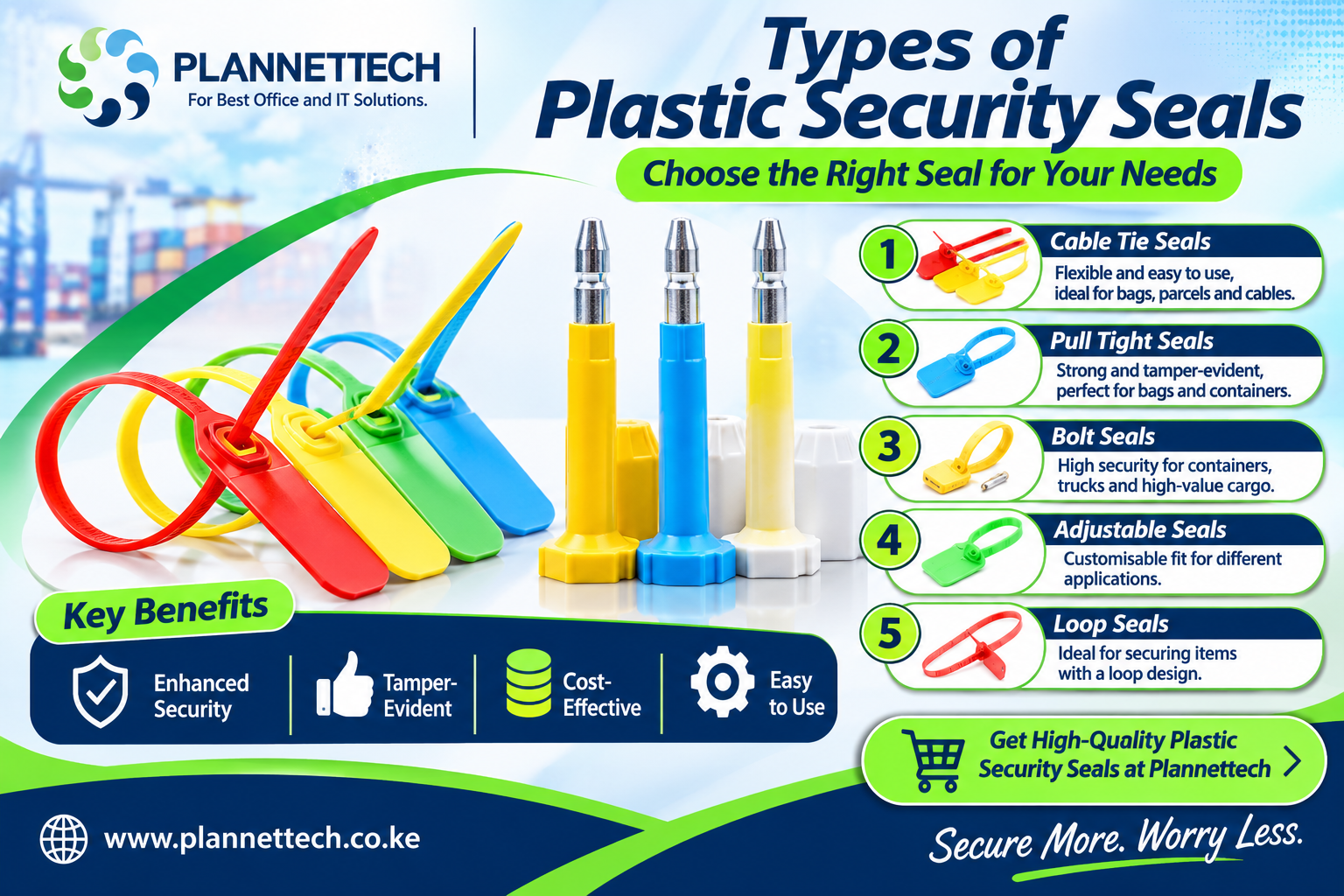
If you move goods, handle cash, store stock or deliver meters, you have probably wondered which of the types of plastic security seals is right for your operation. The types of plastic security seals available today range from simple pull-tight strips to numbered padlock seals and printed meter seals, and each one solves a different problem. This guide explains every major option in plain language so a Kenyan micro or small enterprise can choose with confidence.
Most Kenyan businesses lose money to tampering and pilferage long before they lose it to dramatic break-ins. A sack that was opened in transit, a cash bag that was swapped, or a stock cage that was entered at night can all cost a small business more than the seal that would have prevented it. Understanding the types of plastic security seals helps you match a low-cost tamper-evident device to each of those weak points instead of guessing.
In this article, we cover what plastic security seals are, how the main types of plastic security seals differ, where each one is used, how they compare on strength and cost, and how to apply them correctly. You will also find a practical buying checklist and a detailed FAQ at the end. If you want to see products while you read, browse the security seals range at Plannettech.
What Are Plastic Security Seals?
A plastic security seal is a single-use, tamper-evident device that closes a container, door, bag, meter, or valve so that any attempt to open it leaves visible proof. The types of plastic security seals all share this core idea: the seal does not physically stop a determined thief, but it makes it impossible to open the item without leaving a clear sign that someone did.
Most plastic seals are made from polypropylene, polyethylene, or nylon, and many include a small metal locking insert that grips the strap or tail. Each seal normally carries a unique serial number, and some carry a company name, logo, or barcode. Because of this, the types of plastic security seals double as both a physical closure and an audit record you can check against your delivery notes and stock sheets.
It helps to separate plastic seals from other categories. Heavy-duty bolt seals and cable seals are made of metal and are used where real resistance is needed, such as shipping containers. The types of plastic security seals sit in the indicative group, meaning their value is in showing tampering rather than resisting force. That makes them ideal for the large number of everyday applications where speed, cost, and traceability matter most.
Why the Types of Plastic Security Seals Matter for MSEs and SMEs
A small shop, pharmacy, distributor, or transporter rarely has a dedicated security department. Owners and supervisors handle everything, so any security tool must be cheap, fast, and easy to teach. The types of plastic security seals fit this reality because they are inexpensive, require no tools, and can be applied by a driver, storekeeper, or cashier in a few seconds.
There is also a trust benefit. When a customer, supplier, or auditor sees a numbered seal on a delivery, the types of plastic security seals you use signal that your business controls its process. For SMEs competing for tenders, supermarket supply contracts or logistics work, this small detail often separates a professional operation from an informal one.
Finally, the types of plastic security seals help with accountability inside your own team. When every seal number is recorded at dispatch and checked at receiving, missing goods can be traced to a specific stage and a specific handover. That discipline reduces disputes, protects honest staff and gives you evidence if something goes wrong.
Indicative Versus Barrier Seals: Where Plastic Fits
Security seals are generally divided into indicative seals and barrier seals. Indicative seals show tampering; barrier seals add real physical resistance. Nearly all types of plastic security seals are indicative, and understanding that distinction prevents you from using them in the wrong place.
If you are securing a full container crossing a border, the relevant international benchmark is ISO 17712, which classifies seals as indicative, security or high security. Plastic products are normally in the indicative class, so for container doors you should use a metal bolt seal. Our guide to security seals for containers explains this in detail, and the types of plastic security seals discussed below are better suited to bags, cages, trucks’ side compartments, cabinets, meters and cartons. You can read the standard itself on the ISO website.
The practical rule is simple: use the types of plastic security seals wherever you need low-cost proof of opening, and step up to metal barrier seals where a thief could realistically cut or force the closure. Many businesses use both, with plastic seals on internal and small-package flows and metal seals on high-value or cross-border loads.
The Main Types of Plastic Security Seals
There are several families of plastic seals, and understanding each one makes buying much easier. Below we explain the most common types of plastic security seals found in the Kenyan market, how they lock, and where they work best.
1. Pull-Tight (Adjustable) Plastic Seals
Pull-tight seals are the most popular of all the types of plastic security seals. They consist of a long strap with a locking head. You thread the strap through the hasp, bag handle, or door loop, feed it into the head, and pull until it is tight. Once locked, the strap cannot be loosened, only cut.
Because the strap length is adjustable, one pull-tight seal fits many sizes of closure. This is why this entry among the types of plastic security seals is a favourite for transporters, courier firms, supermarkets and warehouses. Look for versions with a metal locking insert inside the head, which resists attempts to slide the strap back out with a thin tool.
The main limitation is that the long tail can sometimes be trimmed or fiddled with if the design is poor. Choose a quality pull-tight seal with a strong ratchet or locking mechanism, and always check that it is fully tightened. Among all types of plastic security seals, this one rewards good training the most.
2. Fixed-Length Plastic Seals
Fixed-length seals have a set-length strap that is not adjustable. You insert the tip into the head, and it locks at a defined size. They are neater than pull-tight seals because they have no excess tail, and they are the best choice when every closure on your site is a similar size.
Typical uses include cash bags, gas cylinders, fire extinguishers, first-aid kits, lockers and tamper-proof stock cabinets. Since the loop size is predictable, it is harder to slip a hand or tool through the gap. When a business standardises its closures, fixed-length models among the types of plastic security seals give a cleaner, more professional result.
Remember to match the length to the closure. A seal that is too long leaves slack, which defeats the purpose. Measure your hasps and handles once, then buy the matching length so your types of plastic security seals inventory stays simple.
3. Padlock Plastic Seals
Padlock seals look like a small plastic padlock and are used where a rigid, visible closure is preferred. A short, stiff tail locks into a body that often carries a large printed number. Within the types of plastic security seals, they are common in retail, aviation catering, cash handling, and utility cabinets.
The rigid design makes them quick to apply and easy to inspect. A supervisor can glance at a trolley or cabinet and confirm that the padlock seal number matches the paperwork. For fast-moving environments, this is one of the most practical types of plastic security seals because the number can be read from a distance.
Padlock seals are not meant for heavy cargo security. They are best for lightweight closures and for situations where the main goal is proof of opening. Treat this one of the types of plastic security seals as a control tool rather than a physical barrier.
4. Plastic Meter Seals
Meter seals are small, often twist-style or rotor-style devices designed to close electricity, water and gas meters and enclosure covers. They are among the specialised types of plastic security seals used by utilities, estate managers and facility teams who need to detect illegal connections or tampering with readings.
A typical meter seal has a thin transparent or coloured body, a locking mechanism, and a unique serial number printed or laser-marked on it. Because meter tampering is a real concern, this entry among the types of plastic security seals is often paired with a regular inspection schedule where each seal number is recorded and checked.
Property managers and landlords with multiple units can use meter seals to protect shared infrastructure. When selecting this type from the wider types of plastic security seals, choose a model with a clear, durable number that will not fade in sunlight or rain.
5. Snap-Lock and Tail-Lock Plastic Seals
Snap-lock seals are small plastic closures that click together and cannot be reopened without breaking. Tail-lock seals use a short tail that locks into a head. Both are compact members of the types of plastic security seals and are widely used on bags, small boxes, drums, lockers, and tool kits.
They are especially useful when you have many small closures to seal quickly. A pharmacy sealing dispatch boxes, a bank sealing cash pouches, or a school sealing exam material trunks can apply dozens of these in minutes. For high-volume, low-risk tasks, these types of plastic security seals save time and money.
Because they are small, the number must be easy to read, and the locking action must feel firm. Always test a sample from any new batch of these types of plastic security seals before ordering in bulk.
6. Numbered, Barcoded and Custom-Printed Plastic Seals
Most products across the types of plastic security seals can be ordered with sequential numbers, barcodes, QR codes, logos, or company names. Numbered seals let you track each closure; barcoded versions allow scanning into a stock or delivery system; custom-printed seals reinforce your brand and make counterfeiting harder.
For growing businesses, numbering is the feature that turns any of the types of plastic security seals into a real control system. If your seal numbers are logged on delivery notes, invoices or a simple spreadsheet, you can prove what was sealed, when, and by whom.
As your operation scales, you can combine barcoded seals with your point-of-sale or inventory software. That connects the types of plastic security seals to the rest of your retail and logistics workflow, which is where small businesses often see the biggest improvement in loss control.
7. Tamper-Evident Tape, Bags and Related Plastic Closures
Although not seals in the strict sense, tamper-evident bags, void tape and security pouches are related to the types of plastic security seals and often work alongside them. Tamper-evident bags have an adhesive strip that shows a message if peeled; they are common for cash, documents, evidence and pharmaceuticals.
These items are valuable because they secure contents that a strap seal cannot. When you need to secure a loose item such as a cheque bundle or a sample, a tamper-evident bag complements the other types of plastic security seals on your list.
Many businesses buy both categories together. A courier might use pull-tight seals on the cage and tamper-evident bags for parcels inside it, building a layered approach with several types of plastic security seals and related closures.
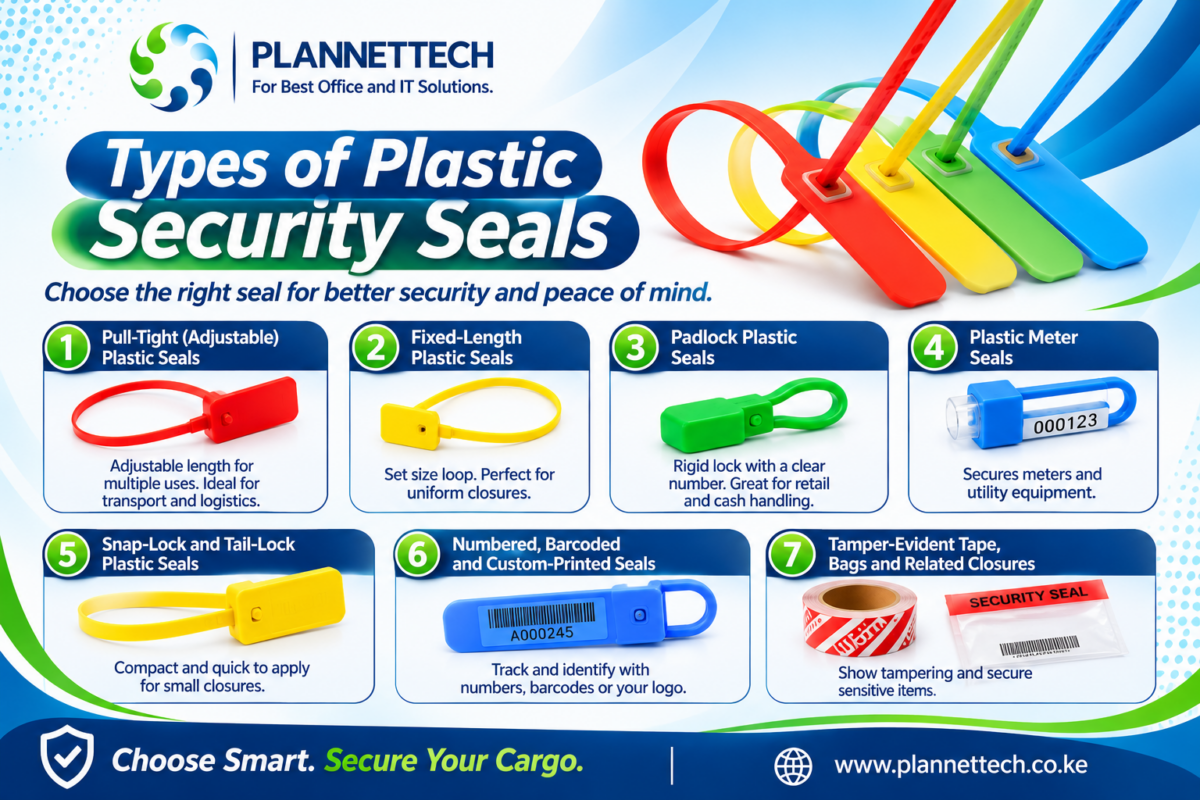
Comparison Table: Types of Plastic Security Seals at a Glance
The table below summarises how the main types of plastic security seals compare in practice. Use it as a quick reference when planning your purchase.
| Seal type | Adjustable? | Best for | Strength level | Typical users |
|---|---|---|---|---|
| Pull-tight | Yes | Truck doors, cages, bags, cartons | Indicative | Transporters, supermarkets, couriers |
| Fixed-length | No | Cash bags, cylinders, cabinets | Indicative | Banks, retailers, facility teams |
| Padlock | No | Trolleys, lockers, utility doors | Indicative | Retail, catering, utilities |
| Meter seal | No | Water, power and gas meters | Indicative | Utilities, property managers |
| Snap-lock / tail-lock | No | Small boxes, bags, kits | Indicative | Pharmacies, schools, clinics |
| Numbered / barcoded | Depends | Any traceable closure | Indicative | Logistics, distribution |
This table of types of plastic security seals shows that none of the options is a barrier seal. If your risk is theft by force rather than tampering, combine the plastic seals above with a metal seal or a proper lock.
Where Each of the Types of Plastic Security Seals Is Used
Different industries lean on different types of plastic security seals. In retail and supermarkets, pull-tight and fixed-length seals protect cash bags, stock cages and delivery crates. Staff can verify them at receiving, and managers can match numbers to the daily sales report that comes from a modern POS system.
In logistics and courier work, the types of plastic security seals used most often are pull-tight and barcoded seals. They lock truck side doors, roll cages and parcel bags, and the serial number is written on the waybill so that the recipient can check it on arrival.
Pharmacies, clinics and laboratories use snap-lock seals and tamper-evident bags to protect medicines, samples and records. Here the types of plastic security seals support compliance by proving that a package was not opened between dispatch and delivery.
Banks, SACCOs and cash-in-transit operators rely on fixed-length and padlock seals for money bags and ATM cassettes. The types of plastic security seals chosen for cash must have unique numbers and a strong locking head so that every bag can be reconciled.
Utilities and property companies depend on meter seals to detect interference. In schools, hospitals, hotels and airlines, padlock and snap-lock seals protect trolleys, first-aid kits and emergency equipment. Across all these sectors, the types of plastic security seals deliver one consistent benefit: fast, visible proof of integrity.
Key Features to Compare Before You Buy
Once you know the types of plastic security seals, the next step is comparing quality. Start with the tensile strength, which tells you how much pulling force the strap can take before it breaks. A stronger strap is harder to snap by hand, so for valuable goods, pick a higher-strength model among the types of plastic security seals.
Next, check the locking mechanism. A metal insert or a ratchet design makes it much harder to defeat the seal with a shim or a thin tool. When you test samples of the types of plastic security seals you are considering, try to pull the strap back out or slide a thin blade into the head. A good seal should resist both.
Then look at the marking. Laser-etched numbers last longer than hot-stamped ones, and bright colours make visual checks quicker. Many businesses assign a colour to each branch, route or shift, which makes the types of plastic security seals easier to manage at a glance.
Finally, consider the environment. Kenyan sun, dust, rain and heat can weaken cheap plastic. UV-resistant and high-quality polypropylene or nylon seals last longer outdoors. Whichever of the types of plastic security seals you choose, ask the supplier whether the material suits your operating conditions.
How to Choose the Right Type for Your Business
Choosing among the types of plastic security seals starts with the item you want to protect. If the closure varies in size, such as different bags and cages, a pull-tight seal is flexible. If every closure is identical, a fixed-length model is neater. For rigid trolleys and cabinets, padlock seals are practical.
Next, think about volume. High-volume businesses should consider numbered or barcoded types of plastic security seals because manual recording gets tedious at scale. A distributor dispatching hundreds of parcels a week will save hours by scanning instead of writing.
Then match the seal to the level of risk. For internal control and proof of opening, plastic is enough. For high-value, cross-border or long-haul loads, step up to metal. For a complete decision framework, read our dedicated guide on how to choose security seals, which builds on the types of plastic security seals covered here.
Budget matters too, but price per seal should be compared against the value of what you are protecting. A few shillings per seal is trivial next to the cost of one lost carton or cash bag. For that reason, most SMEs find that investing in the right types of plastic security seals pays for itself quickly.
Best Practices for Using Plastic Security Seals
The best of the types of plastic security seals will fail if staff apply them carelessly. First, store seals securely. Unused seals should be locked away, with a record of the number range issued to each person. If a thief can get hold of your spare seals, they can reseal a tampered load.
Second, apply the seal properly. Pull it tight, check that the locking head has engaged, and tug firmly to confirm. A half-locked seal among the types of plastic security seals you buy is no better than no seal at all.
Third, record the number. Write the serial number on the delivery note, waybill, or cash register slip, and have the receiver confirm it matches before cutting. The types of plastic security seals only create accountability if the numbers are actually checked.
Fourth, inspect on arrival. Look for signs of tampering such as stretched straps, mismatched numbers, scratched heads or glue marks. Train staff to report any doubt immediately, and keep broken seals for investigation. Using the types of plastic security seals this way turns a small piece of plastic into a reliable control.
Finally, remove seals with cutters rather than by pulling, and dispose of them properly so they cannot be reused. Consistent habits are what make the types of plastic security seals effective in the real world.
Common Mistakes to Avoid
The most frequent mistake is buying the cheapest option without testing it. Low-quality types of plastic security seals can snap, slip or be opened and re-locked with simple tricks. Always request samples and test them before placing a bulk order.
Another mistake is using plastic where metal is needed. Container doors, high-value pallets and cross-border consignments deserve stronger protection than the types of plastic security seals described here. Our article on what a bolt seal is used for explains where to step up.
A third mistake is skipping the paperwork. If the seal number is never recorded or checked, the types of plastic security seals become decoration. Build the number into your standard delivery and receiving process, and make someone responsible for the check.
Businesses also forget to rotate colours and number ranges. If the same colour is used for years, criminals learn to source lookalikes. Changing colours and ranges periodically keeps your types of plastic security seals hard to copy.
Where to Buy Plastic Security Seals in Kenya
When you are ready to buy, choose a supplier that can offer the full set of types of plastic security seals, provide numbering and custom printing, and deliver in Nairobi and across Kenya. Plannettech stocks a range of seals alongside office and retail equipment, so SMEs can source security, stationery and point-of-sale items from one trusted place.
Ask for samples, confirm minimum order quantities, and check lead times for printed seals. Good suppliers will also advise on which of the types of plastic security seals fits your use case instead of simply pushing the most expensive product.
If you are planning a larger purchase, watch for seasonal promotions. Our Black Friday 2026 offers page is the place to check for current deals on business essentials, and you can request a quote for bulk types of plastic security seals through the Plannettech security seals page.
Frequently Asked Questions About Types of Plastic Security Seals
What are the main types of plastic security seals?
The main types of plastic security seals are pull-tight (adjustable) seals, fixed-length seals, padlock seals, meter seals, and snap-lock or tail-lock seals. Most can also be ordered with numbers, barcodes, or custom printing. Each type suits a different closure, from cash bags and cages to utility meters and small boxes.
What is the most commonly used of the types of plastic security seals?
Pull-tight seals are the most widely used of the types of plastic security seals because one seal fits many closure sizes. Transporters, couriers, supermarkets and warehouses prefer them for their flexibility, low cost, and quick application.
Are plastic security seals strong enough for shipping containers?
Generally no. The types of plastic security seals are indicative, meaning they show tampering rather than resist force. Shipping containers should use metal bolt seals that meet ISO 17712 requirements, while plastic seals suit bags, cages, cartons, and internal controls.
What is the difference between indicative and barrier seals?
Indicative seals provide visible proof that something was opened, while barrier seals also add physical resistance. Nearly all types of plastic security seals are indicative, whereas bolt seals and cable seals are barrier seals made of metal.
How do I know if a plastic security seal has been tampered with?
Check whether the serial number matches your records, and look for stretched straps, scratches around the locking head, uneven cuts, or signs of glue. Any mismatch in the types of plastic security seals you use should be treated as a possible breach and reported.
Can plastic security seals be reused?
No. All types of plastic security seals are designed for single use. Once locked, they must be cut to open, and a cut seal must be discarded. Reusing or re-locking a seal destroys its evidence value.
Why do plastic security seals have serial numbers?
Serial numbers let you track each closure and match it to a delivery note, waybill, or cash slip. This is what turns the types of plastic security seals into an audit tool rather than just a piece of plastic.
Which type of plastic security seal is best for cash bags?
Fixed-length and padlock seals are popular for cash handling because they are neat, hard to slip, and easy to number. Among the types of plastic security seals, choose a model with a unique number and a strong locking head, and record each number against the cash count.
Do plastic security seals work for water and electricity meters?
Yes. Meter seals are specialised types of plastic security seals that close meter covers and enclosures so that interference is visible. Utilities and property managers use them together with regular inspections.
Can I get custom-printed plastic security seals in Kenya?
Yes. Many suppliers can print your company name, logo, barcode, or sequence on the types of plastic security seals. Printing makes seals harder to counterfeit and reinforces your brand. Ask for samples and minimum order quantities before ordering.
How much do plastic security seals cost in Kenya?
Prices vary by type, strength, printing, and quantity. Among the types of plastic security seals, simple pull-tight seals are usually the most affordable, while barcoded or custom-printed options cost more. Contact the supplier for a current quote based on your volume.
How do I choose between the different types of plastic security seals?
Start with what you are protecting, then consider closure size, volume, risk level, and environment. Use pull-tight seals for varied closures, fixed-length for identical ones, padlock seals for rigid cabinets, and meter seals for utilities. The types of plastic security seals you pick should always be numbered and recorded.
Conclusion
The types of plastic security seals give Kenyan MSEs and SMEs an affordable way to protect stock, cash, meters, and deliveries. Pull-tight, fixed-length, padlock, meter and snap-lock options each have their place, and numbering or printing turns them from simple closures into a real control system.
The key is to match the seal to the job, test samples before buying, record every number, and step up to metal seals where the risk is higher. Used correctly, the types of plastic security seals reduce losses, settle disputes, and build customer trust.
Ready to secure your business? Explore the full security seals range at Plannettech or contact our team for a quote, and put the right types of plastic security seals to work today.