





How to Choose Security Seals: A Complete Buyer’s Guide for Kenyan Businesses

Every shipment that leaves your premises, every cash bag that goes to the bank, and every utility meter that records consumption carries a quiet risk: someone may open it, take something, and close it again. Knowing how to choose security seals is the simplest way to make that risk visible, and for many Kenyan businesses it is also one of the cheapest controls available. A seal that costs a few shillings can protect goods worth millions, but only if it is the right seal for the job.
Most buyers choose a seal by price or based on what the previous supplier sent. That approach works until the first dispute: a container arrives short, a pharmacy tote is found open, or a customer claims a delivery was tampered with. At that point, the lesson on how to choose security seals becomes expensive. This guide walks you through the decision step by step so that you buy once, buy correctly, and can defend your choice to auditors, insurers and clients.
This article is written for micro and small enterprises (MSEs) and small and medium enterprises (SMEs) in Kenya, as well as larger operators who want a practical framework. By the end, you will know how to choose security seals by risk level, material, marking, compliance, and budget, and you will have a checklist you can print and use at your next purchase.
Why Learning How to Choose Security Seals Matters
Understanding how to choose security seals starts with accepting that theft and tampering rarely happen in dramatic ways. Most losses occur quietly, between loading and delivery, when a door is opened, items are removed, and the load is closed again. Without a seal, nobody can prove when or where that happened. With a properly selected seal, any opening leaves evidence.
The cost of getting it wrong is higher than most owners expect. When you do not know how to choose security seals, you may end up with a lightweight plastic strap on a high-value container, or an expensive bolt seal on a tote bag that only needed a basic tag. Both mistakes waste money: one leaves you exposed, and the other drains your budget.
There is also a trust angle. Customers, banks, insurers, and regulators increasingly ask for proof that goods were protected in transit. A business that can show it understands how to choose security seals, records serial numbers, and inspects seals on arrival is far easier to trust than one that simply “locks the door”. That credibility can influence contracts, claims, and even your insurance premiums.
What a Security Seal Actually Does (and What It Does Not)
Before you decide how to choose security seals, be clear about what a seal is. A security seal is a single-use device that shows whether a door, lid, valve, bag, or container has been opened. It does not physically stop a determined thief the way a heavy padlock might. Its job is to make tampering obvious and traceable.
This distinction matters because it shapes how to choose security seals for different situations. If your goal is evidence, a tamper-evident seal with a unique serial number is enough. If your goal is also delay, you need a high-security seal, usually a bolt or cable seal, that takes real effort and tools to defeat. Many buyers confuse the two and either overspend or under-protect.
A seal is also only as good as the process around it. The best advice on how to choose security seals is useless if staff apply seals loosely, reuse numbers, or never check them at the destination. Think of the seal as one part of a chain: selection, application, recording, inspection, and removal.
Step 1: Define What You Are Protecting
The first step in how to choose security seals is to describe the asset. Ask three questions: what is inside, what is it worth, and how long will it be out of your sight? A carton of printer toners moving across town for two hours does not need the same protection as a sealed container travelling from Mombasa to Kampala over several days.
Write down the closing point as well. When you learn how to choose security seals, the physical opening matters more than the cargo. A container has door locking bars with hasps. A truck may have a roll-up door and a hatch. A cash bag has a zip. A fuel tanker has a manhole cover and valves. Each opening has a different shape, and each shape suits a different seal.
Then consider who might tamper with it. Some risks come from outsiders, such as thieves at a parking stop. Others come from insiders, such as handlers who know the process. Anyone deciding how to choose security seals for internal risk should favour seals with unique numbering, laser marking, and tight control over who can access stock.
Step 2: Know the Main Types of Security Seals
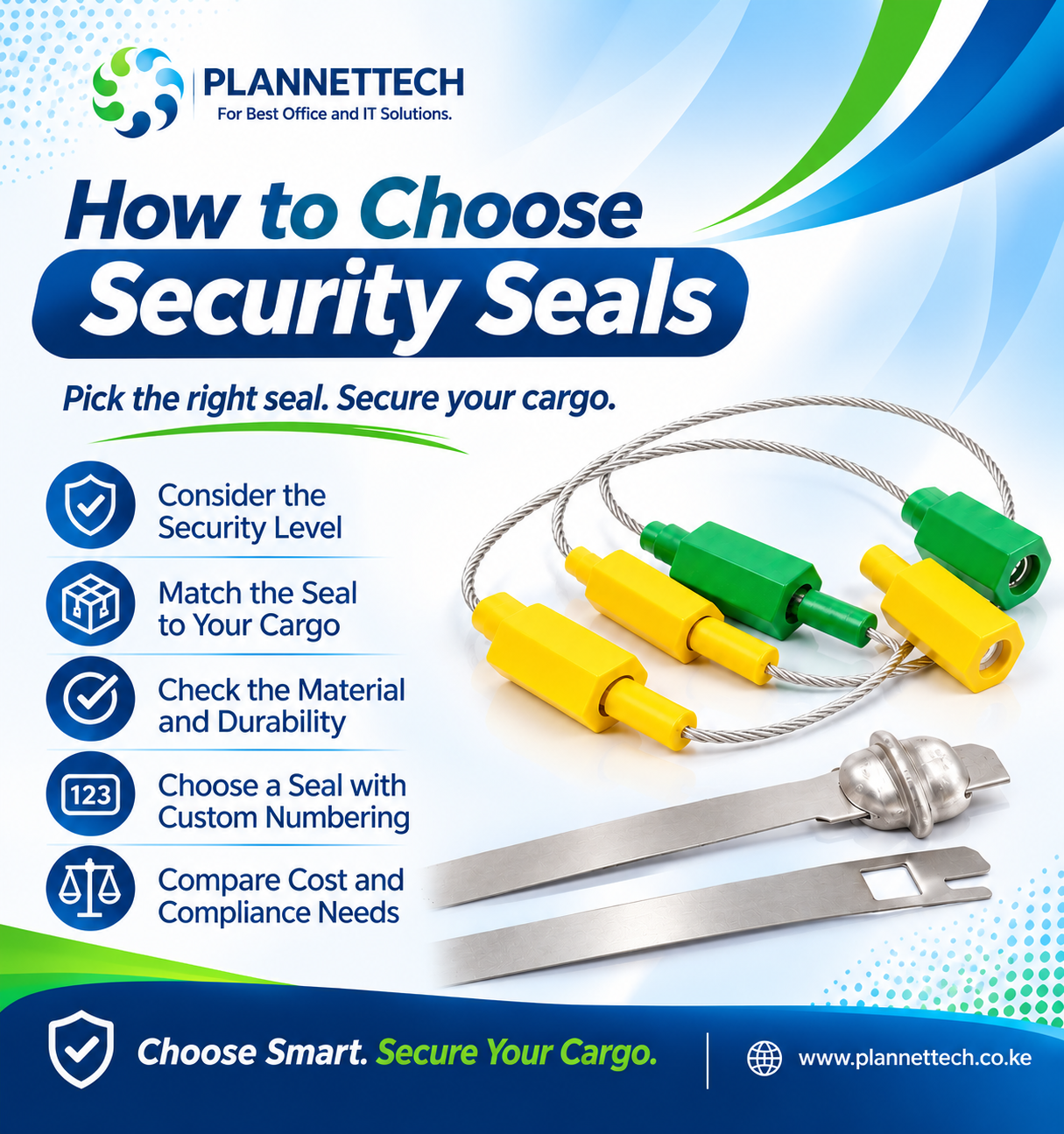
There are several families of seals, and understanding them is central to how to choose security seals with confidence. The table below summarises the most common types used in Kenya and what each is best suited for.
| Seal type | Typical strength | Best used for | Main limitation |
|---|---|---|---|
| Bolt seals | High | Shipping containers, trailers, high-value cargo | Needs bolt cutters to remove, higher unit cost |
| Cable seals | High | Truck doors, tankers, containers, odd-shaped closures | Must be tensioned correctly; cut cable cannot be reused |
| Padlock seals | Medium | Lockers, cabinets, cash boxes, storage rooms | Not suited to heavy cargo |
| Plastic pull-tight seals | Low to medium | Totes, bags, retail cartons, cages | Can be defeated by heat or tools if poorly made |
| Metal strap or strip seals | Medium | Cages, roll doors, valves, meters | Needs correct installation to avoid slipping |
| Meter seals | Low to medium | Electricity, water and gas meters | Designed for evidence, not delay |
| Tamper-evident tape and bags | Low | Documents, cash, samples, parcels | Evidence only, no physical resistance |
When you study how to choose security seals, use this table as a starting filter. Containers and long-haul trucks point towards bolt or cable seals. Day-to-day retail movements point towards plastic or strap seals. Meters and utilities point towards purpose-built meter seals.
Bolt seals
A bolt seal has a metal pin and a locking barrel. Once the pin is pushed into the barrel, it cannot be removed without destroying the seal. For anyone researching how to choose security seals for containers, bolt seals are the industry standard because they meet international high-security requirements and are hard to defeat quickly.
Bolt seals are not all equal. Some are made of hardened steel with a tough barrel, while cheaper versions use softer metals that can be cut with ordinary tools. A good rule of how to choose security seals in this category is to ask whether the product is tested to a recognised standard and whether the supplier can show documentation.
Cable seals
Cable seals use a steel wire that is threaded through the closure and locked into a body. Because the cable adapts to different shapes, they are popular for tankers, truck doors, and any closure that does not suit a rigid bolt. If your question is how to choose security seals for variable closures, cable seals deserve serious consideration.
Thickness is the key factor. Thin cables are quick to install and cheap but easier to cut. Thicker cables, in the range often used for freight, resist cutting far better. Part of how to choose security seals wisely is to match the cable diameter to the risk of the route.
Plastic pull-tight seals
Plastic seals are the workhorse for retail and distribution. They are cheap, numbered, and quick to apply, which makes them useful for cash totes, stock bags, and delivery crates. Anyone deciding how to choose security seals for high-volume, low-risk movement will probably use these most.
The quality of plastic seals varies widely. Better ones have a metal insert in the locking mechanism and a strap that shows visible damage when stretched or cut. When thinking about how to choose security seals in plastic, test a sample: try to pull it open, heat it gently, and see whether it can be reset without marks.
Padlock, strap and meter seals
Padlock seals look like small padlocks but are single-use and numbered. They are used on cabinets, small stores and cash boxes. For a business working out how to choose security seals for internal storage, they offer a clear, reusable-in-process record without the complexity of bolt seals.
Meter seals and strap seals serve a different purpose. They are used mainly by utilities and installers to confirm that equipment has not been interfered with. When learning how to choose security seals for meters, prioritise tamper evidence and clear serial numbering rather than raw strength.
Step 3: Match the Seal to the Risk Level
A useful way to simplify how to choose security seals is to group them into three risk bands. Indicative seals, usually plastic, show tampering but offer little resistance. Security seals add moderate resistance. Barrier seals, such as bolt and heavy cable seals, are built to delay entry as well as show it.
The international standard ISO 17712 classifies mechanical seals as indicative (I), security (S) or high security (H). If you export or handle containers, knowing how to choose security seals that meet this standard is often a contractual requirement. High-security seals are the ones accepted for international container shipping and programmes such as C-TPAT in the United States.
For domestic work, you do not always need ISO-rated seals, but the logic still helps. When thinking about how to choose security seals for a supermarket delivery route, an indicative or security seal may be enough. When thinking about how to choose security seals for a regional container run, step up to high security. The rule is simple: the higher the value and the longer the exposure, the stronger the seal.
Step 4: Check Material and Build Quality
Material is where many buyers go wrong when deciding how to choose security seals. Hardened steel resists cutting, while aluminium and soft alloys are lighter and cheaper but easier to defeat. Plastics vary from brittle polypropylene to tougher nylon, and the difference is obvious once you try to cut or heat them.
Examine the locking mechanism closely. A good seal locks with a distinct click and cannot be pulled apart. A poor one may loosen, can be reset with a pin, or can be peeled open and glued back. Anyone serious about how to choose security seals should ask the supplier for samples and test them before placing a bulk order.
Environment matters too. Kenyan conditions include strong sun, dust, humidity near the coast, and rough handling on poor roads. When deciding how to choose security seals for outdoor use, favour UV-stable plastics and corrosion-resistant metals so that the seal does not degrade before it reaches its destination.
Step 5: Look at Marking, Numbering and Branding
A seal without a unique number is just a piece of plastic. Part of how to choose security seals is insisting on serial numbers that are laser-engraved or hot-stamped, because printed numbers can wear off or be altered. Each number should appear only once in your stock so that duplicates cannot be used to swap a seal.
Custom marking adds another layer. Seals can carry your company name, a logo, a barcode, or a QR code. When working out how to choose security seals for a growing business, barcode-ready seals make recording faster and reduce errors in your log.
Pre-numbered sequences are also useful. Ordering seals in numbered batches lets you spot missing numbers during stock checks. Any team learning how to choose security seals should combine unique numbering with a written register, so that every seal is linked to a shipment, a date and a person.
Step 6: Prioritise Tamper Evidence
The heart of how to choose security seals is tamper evidence. Ask what happens if someone cuts, drills, heats, freezes, or attempts to pick the seal. The best designs leave clear marks, such as torn plastic, deformed metal, or a broken indicator, that even a tired warehouse worker can spot.
Test for common attacks. Try prying the seal, reinserting a cut strap, or using a hairdryer on plastic. If you are unsure how to choose security seals that resist these tricks, ask the supplier which attacks their product was designed to withstand and request test results.
Inspection must be easy. A seal that requires special equipment to read is likely to be ignored. When thinking about how to choose security seals for busy depots, choose designs where damage is visible at a glance, and numbers are large enough to read quickly.
Step 7: Consider Compliance and Industry Requirements
Compliance is a major factor in how to choose security seals for regulated work. Container exporters, importers, and clearing agents deal with port authorities, customs, and shipping lines that may require specific seal types. In Kenya, businesses moving cargo through the port of Mombasa should confirm requirements with their agent and the relevant authorities before purchase.
Other sectors have their own needs. Pharmacies, banks, and cash-in-transit firms often need tamper-evident bags and seals that fit internal audit rules. If your question is how to choose security seals for a regulated industry, ask your auditor or client what documentation they expect and keep copies of supplier specifications.
Tax and record-keeping also play a part. Businesses that manage stock and transport using digital systems, including eTIMS-compliant POS systems, can link seal numbers to delivery notes and invoices. Learning how to choose security seals with traceability in mind makes it easier to reconcile stock and answer queries from customers or authorities.
Step 8: Balance Quantity, Cost and Supplier Reliability
Price is the last factor in how to choose security seals, not the first. Compare the cost of a seal against the value of what it protects. A seal that costs slightly more but prevents a single loss can pay for thousands of units. Cheap seals that fail are the most expensive purchase of all.
Buying in bulk lowers the unit price, but only if your usage is steady. When deciding how to choose security seals for a small business, start with a trial quantity, test the product in real use and reorder once you are satisfied. Avoid stockpiling seals that you may later change specifications on.
Supplier reliability matters as much as the seal. A good supplier offers consistent quality, number sequences without duplicates, fast restocking, and clear advice. In your search for how to choose security seals, prefer a local supplier that can deliver quickly, explain product differences, and support you after the sale.
How to Choose Security Seals by Industry
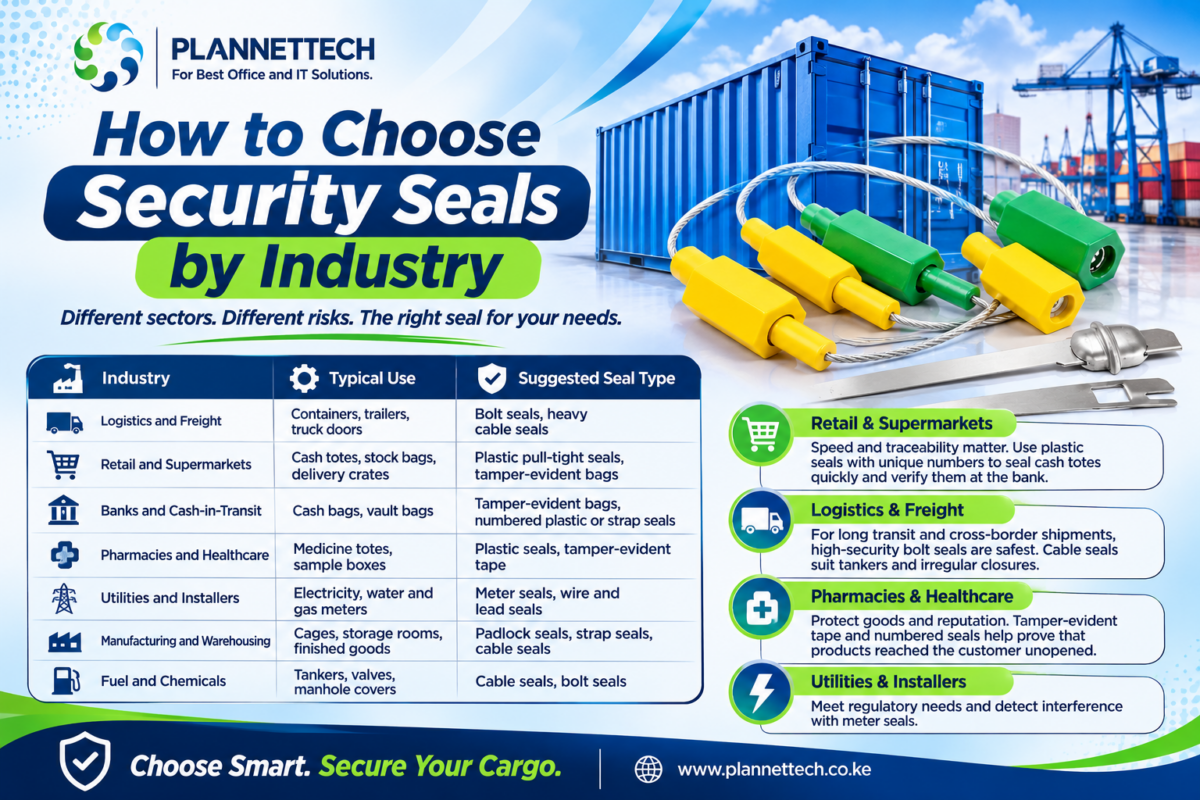
Different sectors face different risks, and the best way to see how to choose security seals in practice is to look at common examples. The table below gives a starting point, which you can adapt to your own routes, values, and policies.
| Industry | Typical use | Suggested seal type |
|---|---|---|
| Logistics and freight | Containers, trailers, truck doors | Bolt seals, heavy cable seals |
| Retail and supermarkets | Cash totes, stock bags, delivery crates | Plastic pull-tight seals, tamper-evident bags |
| Banks and cash-in-transit | Cash bags, vault bags | Tamper-evident bags, numbered plastic or strap seals |
| Pharmacies and healthcare | Medicine totes, sample boxes | Plastic seals, tamper-evident tape |
| Utilities and installers | Electricity, water and gas meters | Meter seals, wire and lead seals |
| Manufacturing and warehousing | Cages, storage rooms, finished goods | Padlock seals, strap seals, cable seals |
| Fuel and chemicals | Tankers, valves, manhole covers | Cable seals, bolt seals |
For retail and supermarkets, how to choose security seals comes down to speed and traceability. Staff must seal cash totes quickly at the end of a shift and managers must be able to verify them at the bank. Plastic seals with unique numbers and a simple register usually meet that need.
For logistics and freight, how to choose security seals is a more serious decision. Containers can be out of sight for days and cross borders, so high-security bolt seals with documented standards are the safest option. Cable seals suit tankers and irregular closures where a bolt will not fit.
For pharmacies, clinics and healthcare suppliers, how to choose security seals involves protecting both goods and reputation. Tamper-evident tape and numbered plastic seals on medicine totes help prove that products reached the customer unopened, which matters when handling sensitive stock.
For utilities and installers, how to choose security seals is shaped by regulation and the need to detect interference. Meter seals with clear serial numbers allow field staff to check for tampering quickly and support investigations when readings look suspicious.
Common Mistakes When Choosing Security Seals
One of the most common errors in how to choose security seals is buying on price alone. Very cheap seals may be made from weak materials, have duplicate numbers or lock poorly. A single failure can wipe out any savings, so judge value rather than unit price.
Another mistake is ignoring the closure. Buyers who do not think about how to choose security seals for the actual hasp, door bar, or bag end often discover that the seal is too short, too thick, or the wrong shape. Always measure the opening and test a sample on the real item before ordering.
A third error is skipping control procedures. Even if you know how to choose security seals perfectly, leaving them in an unlocked drawer or letting any staff member issue them undermines the system. Treat seals like cash: store them securely, issue them by number, and record who used each one.
Finally, many businesses forget to inspect seals on arrival. Understanding how to choose security seals is only half the job. A seal that is never checked cannot reveal tampering. Train receiving staff to compare the number on the seal with the paperwork and to report any mismatch immediately.
Build a Simple Seal Control Procedure
A good procedure completes the lesson on how to choose security seals. Start by appointing a single custodian for seal stock. Keep seals in a locked cabinet, log every issue by number and require a signature for each batch collected.
At loading, record the seal number on the delivery note, dispatch form, or digital system. This step connects how to choose security seals to your daily workflow. When the driver, customer, and warehouse all see the same number, disputes become easy to resolve.
At delivery, the receiver should inspect the seal before opening, compare it to the paperwork, cut it, and keep the broken seal as evidence if anything looks wrong. Teams that understand how to choose security seals should also understand that removal is part of the audit trail, not an afterthought.
Finally, review the data. Monthly checks of used and unused seal numbers will reveal gaps and patterns. Over time, your records will show where losses cluster and help refine how to choose security seals for specific routes, drivers, or customers.
A Practical Checklist: How to Choose Security Seals
Use this checklist at your next purchase. It condenses everything above into a quick decision tool for how to choose security seals without missing key factors.
- Define what you are protecting, its value, and how long it will be out of your control.
- Identify the exact closure: container door, truck hatch, bag, cage, cabinet, valve, or meter.
- Choose the seal family that fits the closure and risk: bolt, cable, padlock, plastic, strap or tape.
- Decide whether you need an indicative, security, or high-security level.
- Check material quality and test a sample for strength and resetting.
- Insist on unique, laser-engraved or hot-stamped serial numbers.
- Confirm any compliance or client requirements before ordering.
- Compare total cost, not just unit price, and start with a trial order.
- Set up storage, issue, recording, and inspection procedures.
- Review results regularly and adjust your approach.
Where to Buy Security Seals in Kenya
Once you know how to choose security seals, the next step is finding a dependable source. Plannettech supplies security seals for logistics, retail, banking and industrial customers, alongside the printers, POS systems and stationery that many of the same businesses already buy from us. You can browse the full security seals range and compare options by type.
If you handle containers, you may want to read our guide on security seals for containers alongside this article. It builds on how to choose security seals by going deeper into bolt seals, cable seals and container-specific requirements.
Not sure what each product does? Our explainer on what a bolt seal is used for is a good companion to this guide on how to choose security seals, especially if you are new to freight security.
If you need help with your order, you can contact the Plannettech team and describe your closure, route, and budget. We will recommend options so that you do not have to guess how to choose security seals on your own.
We also support wider business needs, including eTIMS-compliant POS systems and office stationery, so you can manage supply and security from one local supplier.
Trusted Resources for Further Reading
If you want to go deeper into how to choose security seals, several external sources are useful. The International Organization for Standardization publishes ISO 17712, the benchmark for mechanical seals used on freight containers. Reading its summary will help you understand why high-security seals are classified the way they are.
For exporters and logistics companies, the U.S. Customs and Border Protection C-TPAT programme explains supply chain security expectations. It is a helpful reference when you are working out how to choose security seals that satisfy international partners.
In Kenya, the Kenya Bureau of Standards and the Kenya Ports Authority are worth checking for local standards and port procedures. Pair them with guidance from the Kenya Revenue Authority on customs and cargo documentation, and you will have a solid picture of how to choose security seals that fit regulatory expectations.
The World Customs Organization also publishes frameworks on secure global trade. Browsing these materials will deepen your understanding of how to choose security seals for cross-border movement and customs-controlled goods.
Frequently Asked Questions About How to Choose Security Seals
What is the first thing to consider in how to choose security seals?
The first thing to consider in how to choose security seals is the closure and the value of what you are protecting. Measure the opening, note the risk level and decide whether you need only tamper evidence or also physical resistance. Everything else, from material to price, follows from that decision.
What is the best type of security seal for containers?
For containers, how to choose security seals usually leads to high-security bolt seals that meet ISO 17712. They are hard to remove without tools and are widely accepted by shipping lines, customs, and ports. Heavy cable seals can be a good alternative for irregular closures.
How do I know if a security seal is tamper-evident?
When you learn how to choose security seals, test for tamper evidence by trying to cut, pry, heat, and reset a sample. A good seal will show visible damage, cannot be reused, and has a unique serial number. If it can be reset without marks, it is not suitable for serious use.
Are plastic seals secure enough for business use?
Plastic seals are secure enough for low- and medium-risk applications, such as retail totes, cash bags, and local deliveries. In how to choose security seals for higher-value or long-haul cargo, plastic alone is usually not enough, and metal bolt or cable seals are safer.
What is the difference between indicative, security and high-security seals?
Indicative seals show tampering but offer little resistance; security seals add moderate strength, and high-security seals are designed to delay entry as well as reveal it. Understanding these categories is central to how to choose security seals that match your risk.
Do I need ISO 17712 seals in Kenya?
You need ISO 17712 seals if you handle international container shipping or work with clients who require them. For purely domestic movement, how to choose security seals depends on risk and contracts, but ISO-rated products are a reliable benchmark for quality.
How much should I spend on security seals?
Spend in proportion to the value and risk of the goods. In how to choose security seals, compare the unit cost against the potential loss, not against the cheapest alternative. A slightly higher price for a reliable seal is usually cheaper than one failed shipment.
Can security seals be reused?
No. Security seals are single-use devices, and reuse defeats their purpose. A key principle in how to choose security seals is to select products that cannot be reset or reused, and to destroy and record them on removal.
What is the difference between a bolt seal and a cable seal?
A bolt seal uses a rigid metal pin and barrel and is suited to container doors, while a cable seal uses a flexible steel wire and suits irregular closures such as truck hatches and tankers. Both can be high security, so how to choose security seals between them depends on the shape of the closure.
How do I control and track security seals in my business?
Store seals in a locked cabinet, issue them by number, record each number against a shipment, and inspect on arrival. This procedure is as important as how to choose security seals in the first place, because tracking turns each seal into usable evidence.
Where can I buy security seals in Kenya?
You can buy security seals from local suppliers such as Plannettech, which offers bolt, cable, plastic, and other types for different industries. When deciding how to choose security seals, choose a supplier that provides samples, consistent numbering, and fast delivery.
How many security seals should I order at first?
Start with a small trial order to test fit, strength, and workflow, then scale up. In how to choose security seals for a growing business, testing first prevents waste and ensures the product suits your real operating conditions.
Conclusion: Make Your Next Seal Purchase a Confident One
Knowing how to choose security seals comes down to a clear sequence: define what you are protecting, match the seal type to the closure, set the right security level, check material and numbering, confirm compliance, and then balance cost against risk. Follow these steps, and you move from guessing to deciding.
Beyond the product, remember that how to choose security seals is only part of a wider system. Storage, recording, and inspection are what turn a seal from a plastic or metal device into reliable evidence. Businesses that treat seals as part of their process, not an afterthought, see fewer losses and resolve disputes faster.
If you would like help with how to choose security seals for your containers, trucks, totes, or meters, speak to the Plannettech team today. Share your closure type, route, and budget, and we will recommend the right seal so that your next shipment arrives exactly as it left.